'/%3e%3cpath%20d='M31%2038c0-8%206-14%2014-14h38c8%200%2014%206%2014%2014v52c0%208-6%2014-14%2014H45c-8%200-14-6-14-14V38z'%20fill='url(%23tmPanel)'%20filter='url(%23tmShadow)'/%3e%3cpath%20d='M44%2044h40'%20fill='none'%20stroke='%23f97316'%20stroke-width='8'%20stroke-linecap='round'/%3e%3cpath%20d='M44%2061h24'%20fill='none'%20stroke='%23fdba74'%20stroke-width='8'%20stroke-linecap='round'/%3e%3cpath%20d='M43%2087l13-14%2011%2010%2017-21%202%2025H43z'%20fill='%23fb923c'/%3e%3ccircle%20cx='84'%20cy='58'%20r='6'%20fill='%23f97316'/%3e%3cpath%20d='M77%2091l16-18%2014%2014'%20fill='none'%20stroke='%2316a34a'%20stroke-width='7'%20stroke-linecap='round'%20stroke-linejoin='round'/%3e%3cpath%20d='M99%2074h-6v-6'%20fill='none'%20stroke='%2316a34a'%20stroke-width='7'%20stroke-linecap='round'%20stroke-linejoin='round'/%3e%3cpath%20d='M30%2034c8-10%2020-15%2034-15s26%205%2034%2015'%20fill='none'%20stroke='%23fff7ed'%20stroke-width='5'%20stroke-linecap='round'%20opacity='.92'/%3e%3cpath%20d='M27%2096c9%208%2021%2012%2037%2012s28-4%2037-12'%20fill='none'%20stroke='%23fff7ed'%20stroke-width='5'%20stroke-linecap='round'%20opacity='.72'/%3e%3c/svg%3e)
How to scarify a lawn in autumn: timing, the thatch test and when to use a machine
Scarify in September or October, or in October and early November if moss is the main problem, while the grass is still growing strongly. Check for thatch first, rake in two directions, clear the debris, then aerate and repair bare patches. This guide follows RHS advice and compares a corded lawn raker with a cordless scarifier for bigger lawns.
Quick answer: Scarify in early autumn, when the RHS says lawn jobs are best done (September or October), or in October and early November if your main aim is removing moss, because the grass is still growing strongly and recovers before winter. First check for thatch: if you cannot see soil between the blades of grass, the lawn will benefit. Rake vigorously with a spring-tine rake, one direction then the other, remove everything you pull out, then aerate and repair bare patches. On a small lawn a rake is enough; on a larger one, a powered scarifier saves a lot of effort.
What scarifying does, and why autumn
Scarifying is raking out thatch, which the RHS describes as old grass clippings, moss and other debris sitting on the soil surface. Thatch acts like a sponge on top of the soil: it stops water getting down to the roots, which makes the lawn less able to cope with drought, and it reduces air circulation between the grass plants, which the RHS links to fungal problems.
The timing comes from the grass, not the calendar. After summer wear, the RHS says the mild, damp conditions of early autumn are ideal for lawn maintenance, and the grass should recover well before winter. Its moss page is more specific: to remove moss, scarify ideally in October or early November, while the grass is growing strongly. The lawn will look rough for a few weeks afterwards; the RHS says it soon recovers and grows better in the long run.
The thatch test (two minutes)
Part the grass with your fingers in a few places, including the shadiest and the most worn spots. The RHS rule of thumb: if you cannot see the soil between the blades of grass, the lawn would benefit from scarifying. A thin, springy layer is normal. A thick, spongy mat, or lots of moss, is the reason to act.
Not every lawn needs scarifying every year. The RHS says its autumn tasks do not all need doing annually, so if time is short, pick the one or two your lawn needs most.
When to hold off
Use some common sense about conditions on the day. Our editorial advice, following from the RHS reasoning that scarifying relies on the grass growing strongly afterwards:
- Waterlogged or frozen ground: blades and boots tear up soft soil and the grass will not regrow quickly. Wait for a drier spell.
- Drought-stressed grass: a brown, dormant lawn has little growth left to recover; wait until autumn rain has greened it up.
- A lawn sown or turfed this year: young grass is easily pulled out. Let it establish first.
- Late in the year: once growth slows down in a cold spell, recovery takes much longer.
Step by step
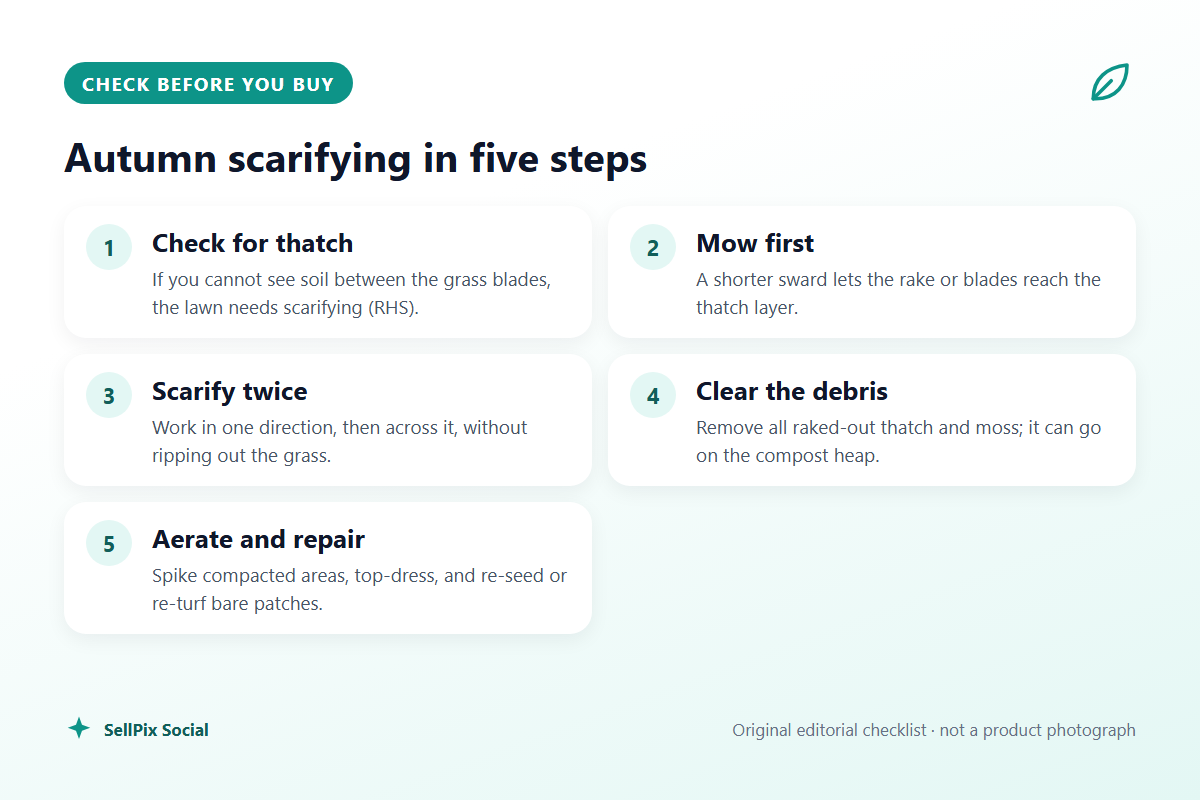
- Mow the lawn a little shorter than usual a day or two before, so the rake or blades reach the base of the grass.
- Deal with heavy moss first if needed. The RHS describes moss killers that leave dead, black moss that then has to be raked up, and also bacteria-based moss removers; whichever you use, follow the label and rake afterwards. The RHS warns that iron sulphate sold as a lawn fertiliser should not be used to control moss unless it is part of a proprietary, HSE-approved lawn mosskiller.
- Scarify. The RHS method: rake vigorously with a spring-tined rake, aiming to remove loose debris without uprooting the grass. Work first in one direction, then the other. With a powered scarifier, start on the shallowest working depth and only go deeper if little is coming out.
- Clear everything. Remove all the raked-out thatch. The RHS says it can go on the compost heap; moss rots slowly, so mix it with other material.
- Aerate compacted areas. The RHS suggests spiking with a garden fork, holes 10 to 15cm apart and as deep as the tines go, concentrating on the most worn areas. For most lawns, aerating every two to three years is enough; on clay or waterlogged soil, a hollow-tined aerator every three to four years works better.
- Top-dress and repair. Brush a top dressing into the holes (the RHS gives a home mix of three parts sandy loam, six parts sharp sand and one part well-rotted compost) and re-seed or re-turf bare patches. Autumn is, the RHS says, the ideal time for lawn repairs.
- Feed only if the lawn is hungry, with a feed made for autumn use, which the RHS says encourages root growth rather than leafy growth.
Rake or machine?
The RHS says that on a small lawn, or where moss is limited, a spring-tined rake will do, and for larger lawns it suggests hiring or buying a powered scarifier (or simply raking a different section each autumn). That leaves a practical question of size and effort:
| Your lawn | Sensible tool | What to check |
|---|---|---|
| Small, little moss | Spring-tine rake | Comfortable handle length; you will be raking hard |
| Small to medium, socket nearby | Corded scarifier or lawn raker | Cable reach from an outdoor-safe socket; RCD protection |
| Medium, no handy socket | Cordless scarifier | Battery platform you already own; batteries not always included |
| Large, or a one-off job | Hire a petrol scarifier | Transport and collection; hire terms |
Home machines come in two broad types. A scarifier has a roller of fixed blades that slice into the thatch; a lawn raker uses a roller of wire tines that comb it out, closer to the RHS's spring-tine rake method but powered. Many scarifiers can also take an optional second roller with spring tines or claws, which makers call an aerator or fan roller. That roller rakes the surface; it is not the same as hollow-tine aeration and does not relieve compaction the way a fork or hollow-tine aerator does.
Buying decision
Choose the BLACK+DECKER GD300 if your lawn is small to medium and you have an outdoor socket within reach: it is a corded 600 W lawn raker with a 30cm raking width, three raking heights and a front grass box, and it needs no batteries. Choose the Einhell GC-SC 18/28 Li if there is no convenient socket or you already own Einhell Power X-Change batteries: it is a cordless 18 V scarifier with a 28cm blade roller that Einhell recommends for lawns up to about 200 m², but it is sold without battery, charger or collection bag. Skip both and use a spring-tine rake if your lawn is small and the moss is patchy, or hire a petrol scarifier for a large lawn.
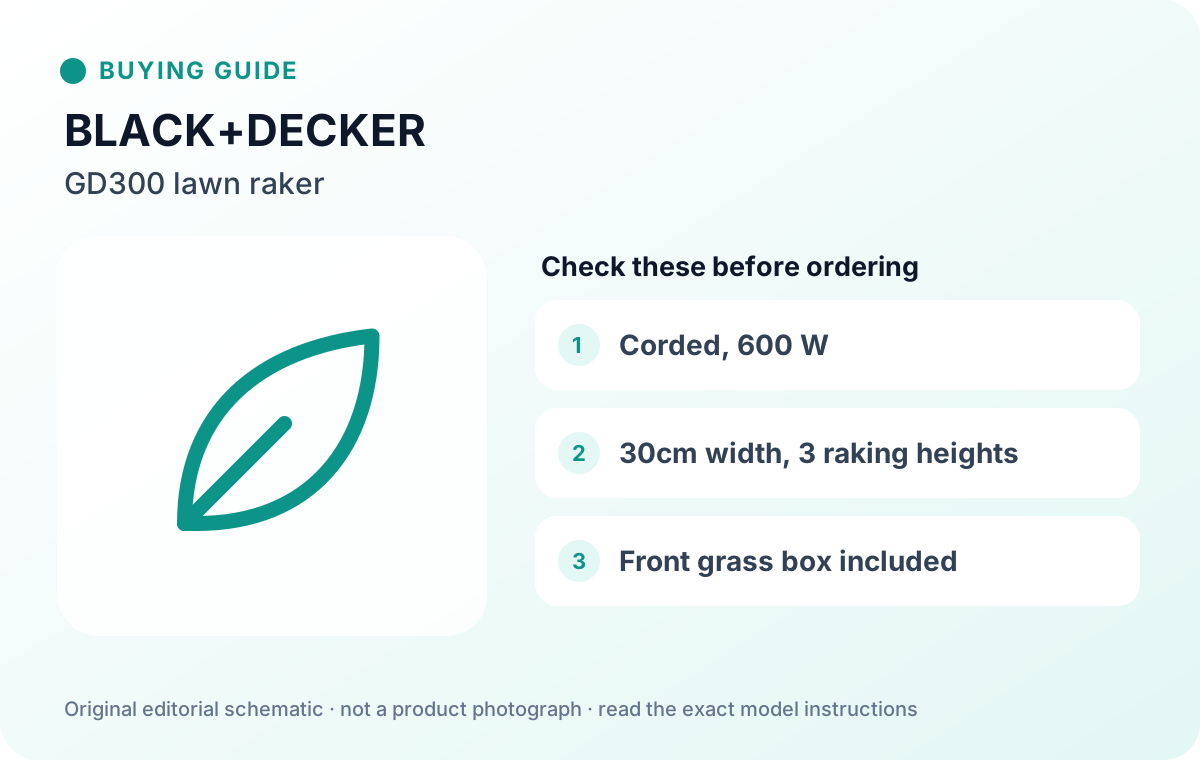
BLACK+DECKER 600W Lawn Raker, GD300-GB
A corded electric lawn raker that combs moss, thatch and debris into a front-loading grass box. BLACK+DECKER aims it at medium gardens, with a 30cm raking width and three raking heights.
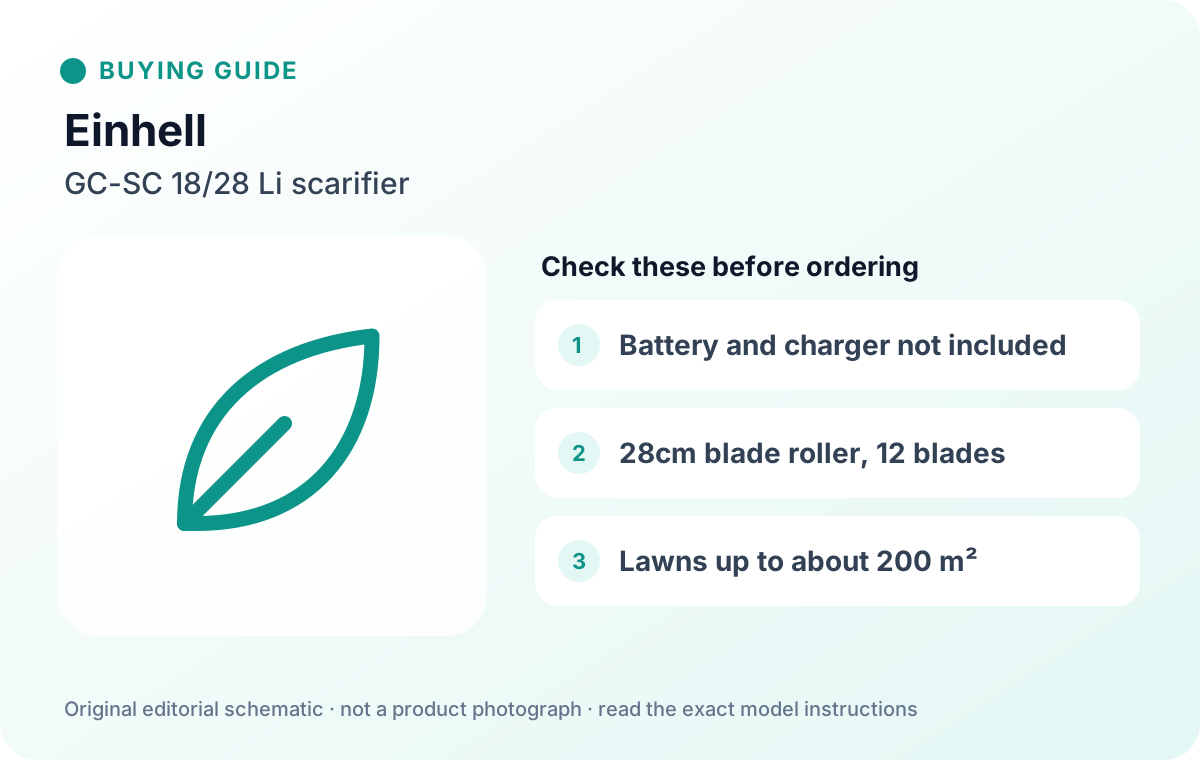
Einhell GC-SC 18/28 Li-Solo Cordless Lawn Scarifier, 28cm, 18V Power X-Change (without battery)
A cordless 18 V blade scarifier from Einhell's Power X-Change range, sold as the bare machine. Einhell recommends it for lawns up to 200 m², depending on the battery.
| BLACK+DECKER GD300 | Einhell GC-SC 18/28 Li (solo) | |
|---|---|---|
| Type | Lawn raker | Scarifier (blade roller) |
| Power | Mains, 600 W, corded | 1 x 18 V Power X-Change battery, not included |
| Working width | 30cm | 28cm |
| Depth settings | 3 raking heights | 3-stage working depth (maker feature list) |
| Collection | Front grass box included | Collection bag sold separately |
| Weight | 7 kg (listing) | 5.93 kg (maker page) |
| Maker's lawn size | Medium gardens (maker page) | Up to 200 m², battery-dependent |
Before you order
- The Einhell link is the "solo" body: budget for an 18 V Power X-Change battery and charger, plus the separate collection bag if you want one.
- For the corded GD300, measure the cable run from your outdoor socket and use RCD protection.
- A raker combs; a blade scarifier cuts. If your thatch is thick and matted, a blade roller does more per pass.
- Plan where the raked-out thatch will go; a moss-heavy lawn fills a grass box quickly.
- Have grass seed for bare patches ready before you start.
FAQ
When is the best time to scarify a lawn in the UK?
The RHS recommends autumn lawn care in September or October, and for moss removal ideally October or early November while the grass is still growing strongly. Avoid frozen, waterlogged or drought-stressed ground.
How do I know if my lawn needs scarifying?
Part the grass. If you cannot see soil between the blades, the RHS says the lawn would benefit. A thick, spongy layer or lots of moss confirms it.
Should I aerate before or after scarifying?
After. Scarify, clear the debris, then aerate compacted areas, top-dress and re-seed. That is the order the RHS autumn guide follows.
What is the difference between a lawn raker and a scarifier?
A raker uses wire tines to comb out moss and loose thatch; a scarifier uses blades that cut into the thatch layer. Both do the job the RHS describes; the blades go further on a heavily matted lawn.
How often should I scarify?
Only when the thatch test says so. The RHS notes that autumn lawn jobs do not all need doing every year.
How we researched this
We read the RHS guides to autumn lawn care and moss on lawns, Einhell UK's GC-SC 18/28 Li-Solo page and BLACK+DECKER UK's GD300 page on 10 October 2026, and checked both Amazon.co.uk listings the same day. Our first choices, Einhell's corded GC-SA 1231/1 and cordless GE-SA 36/35 Li, were not available as complete machines on Amazon.co.uk when we checked, so we swapped them. We did not use these machines; the conditions to avoid are editorial reasoning from the RHS guidance rather than a quoted rule. Buying links and any commission relationship are disclosed on this page.