'/%3e%3cpath%20d='M31%2038c0-8%206-14%2014-14h38c8%200%2014%206%2014%2014v52c0%208-6%2014-14%2014H45c-8%200-14-6-14-14V38z'%20fill='url(%23tmPanel)'%20filter='url(%23tmShadow)'/%3e%3cpath%20d='M44%2044h40'%20fill='none'%20stroke='%23f97316'%20stroke-width='8'%20stroke-linecap='round'/%3e%3cpath%20d='M44%2061h24'%20fill='none'%20stroke='%23fdba74'%20stroke-width='8'%20stroke-linecap='round'/%3e%3cpath%20d='M43%2087l13-14%2011%2010%2017-21%202%2025H43z'%20fill='%23fb923c'/%3e%3ccircle%20cx='84'%20cy='58'%20r='6'%20fill='%23f97316'/%3e%3cpath%20d='M77%2091l16-18%2014%2014'%20fill='none'%20stroke='%2316a34a'%20stroke-width='7'%20stroke-linecap='round'%20stroke-linejoin='round'/%3e%3cpath%20d='M99%2074h-6v-6'%20fill='none'%20stroke='%2316a34a'%20stroke-width='7'%20stroke-linecap='round'%20stroke-linejoin='round'/%3e%3cpath%20d='M30%2034c8-10%2020-15%2034-15s26%205%2034%2015'%20fill='none'%20stroke='%23fff7ed'%20stroke-width='5'%20stroke-linecap='round'%20opacity='.92'/%3e%3cpath%20d='M27%2096c9%208%2021%2012%2037%2012s28-4%2037-12'%20fill='none'%20stroke='%23fff7ed'%20stroke-width='5'%20stroke-linecap='round'%20opacity='.72'/%3e%3c/svg%3e)
How to brush your dog's teeth: a step-by-step start and the right toothpaste
Start with a taste of pet toothpaste, then gum touches, a finger brush and finally a dog toothbrush, over a few weeks. This guide follows PDSA's sequence, explains why human toothpaste is out, lists the signs that need a vet rather than a brush, and looks at two starter products on Amazon.co.uk.
Quick answer: Build up over a few weeks: let your dog taste a pet toothpaste, get it used to having its gums touched, then use a finger brush and finally a dog toothbrush. PDSA advises brushing daily, or at least three times a week, with toothpaste made for pets because it is safe to swallow. Never use human toothpaste, mouthwash or antibacterial gels. Brushing is prevention; a dog with bad breath, sore or bleeding gums or loose teeth needs a vet check, not a new brush.
Why brushing is worth the effort
PDSA's Pet Health Hub says regular brushing significantly lowers the risk of serious dental problems and of repeated anaesthetics for dental treatment. Brushing works by removing soft plaque from the tooth surface every day, before it hardens. That is why frequency matters more than any particular product: a routine of a minute a day does more than an occasional long session.
It also gives you a regular look inside your dog's mouth, which is useful because many dogs with dental disease show no obvious symptoms.
What you need
| Item | Why | What to check |
|---|---|---|
| Pet toothpaste | Safe to swallow; dogs cannot rinse and spit | Made for dogs (or dogs and cats), flavour your dog likes |
| Soft cloth or gauze | Step 2: gets your dog used to gum contact | Clean and damp |
| Finger brush | Step 3: small, soft, you feel what you are doing | Soft silicone; replace when worn |
| Dog toothbrush | Step 4: longer handle reaches the back teeth | Head size to suit your dog's mouth |
| Treats or praise | Reward-based training throughout | Small and quick to give |
The four-step introduction
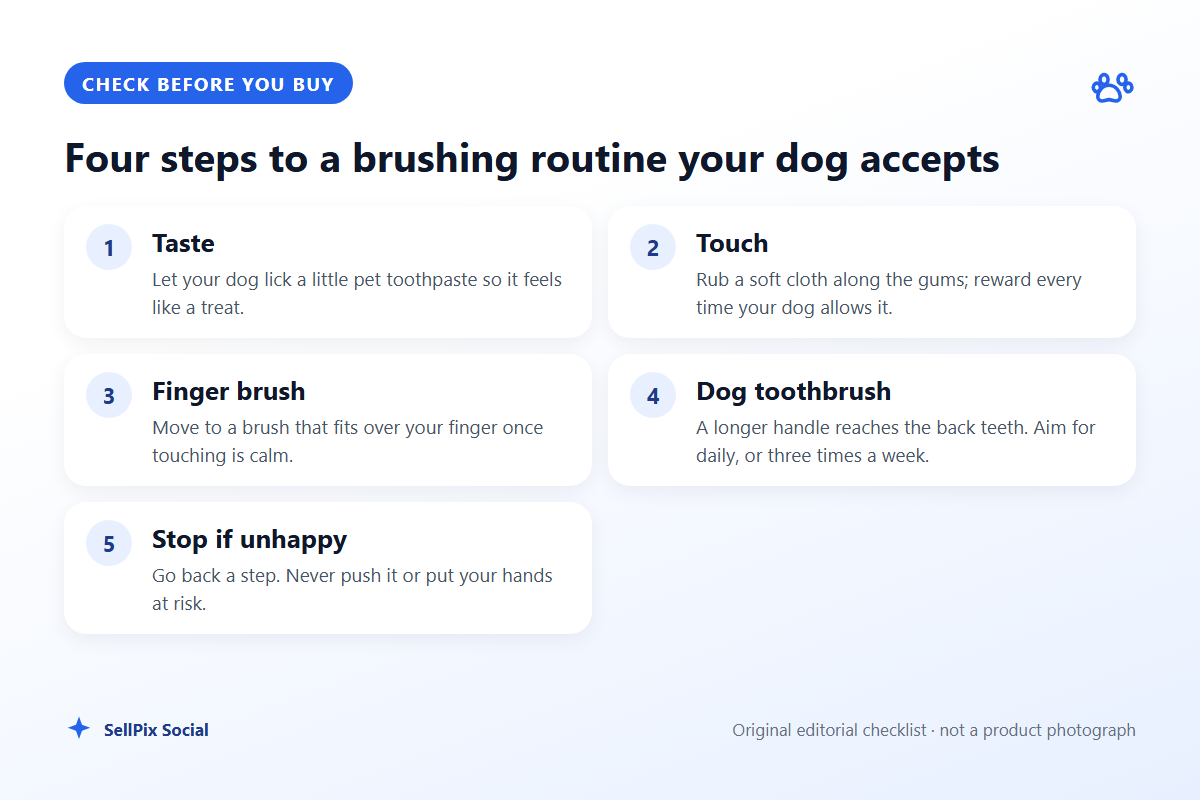
PDSA recommends going slowly over a few weeks and using reward-based training at each stage.
- Taste. Put a little pet toothpaste on your finger and let your dog lick it, so the toothpaste feels like a treat. Virbac's own instructions for its C.E.T. paste start the same way, with a taste first.
- Touch. Rub a soft cloth along the gums, a few teeth at a time, rewarding your dog each time it accepts this. Keep sessions short and stop on a good note.
- Finger brush. Once gum contact is calm, switch to a brush that fits over your finger. Lift the lip at the side and work along the outer surfaces of the teeth and the gum line.
- Dog toothbrush. When your dog is comfortable, move on to a proper dog toothbrush. PDSA notes that the longer handle helps you reach all the teeth, including the back molars.
If your dog objects to having its mouth handled, PDSA's advice is not to push it and never to put yourself at risk. Go back a step, shorten the session, or ask your vet practice to show you.
How often, and for how long
PDSA advises brushing daily, or at least three times a week. Virbac's maker page likewise describes its toothpaste as gentle enough for daily use. There is no need to brush every surface perfectly at the start; consistency matters more. Once the routine is established, work round the whole mouth, paying particular attention to the back teeth and the gum line.
Toothpaste: pet only
Human toothpaste is designed to be spat out, and dogs swallow whatever is in their mouth. PDSA says to use toothpaste made for pets, which is safe for dogs to swallow, and never to use human mouthwash or antibacterial gels. Pet toothpastes are usually flavoured; Virbac's C.E.T. comes in poultry and fish. Some contain enzymes; Virbac, for example, says its C.E.T. formula uses two enzymes to help control bacterial plaque. Treat that as a maker claim about a preventive product, not a treatment.
Signs that need a vet, not a brush
PDSA lists signs of dental disease in dogs, including:
- bad breath
- pain or difficulty eating, such as chewing on one side
- yellowish-brown plaque or tartar
- red, swollen or bleeding gums
- wobbly, missing or broken teeth
- drooling, sometimes with blood, or preferring soft food
- facial swelling
- pawing at the mouth, head shaking or dropping food
If you see any of these, contact your vet before starting or continuing a brushing routine; brushing a painful mouth can make your dog more resistant. PDSA advises an urgent appointment if your dog cannot close its mouth or is in too much pain to eat. Visible yellow-brown tartar is itself on PDSA's list, so treat it as a reason for a vet check rather than harder brushing.
Buying decision
For a dog that has never been brushed, buy a pet toothpaste and a finger brush first: they cover steps 1 to 3, which is where most owners give up. Choose the Virbac C.E.T. Enzymatic Toothpaste (poultry) if you want a low-foaming paste the maker says can be swallowed without rinsing and that is labelled for cats and dogs of all ages. Choose the Beaphar Finger Toothbrush 2-pack for the finger-brush stage, especially for puppies, small dogs or sensitive mouths. Skip both and see your vet first if your dog shows any of the warning signs above.
Virbac C.E.T. Enzymatic Toothpaste for Dogs, Poultry Flavour
A poultry-flavoured pet toothpaste that the listing describes as low-foaming and safe to swallow without rinsing, for cats and dogs of all ages and breeds.
Beaphar Finger Toothbrush for Cats and Dogs, soft silicone, 2 brush pack
A soft silicone brush that slips over your finger, sold as a pair. The listing pitches it at sensitive or young pets and as a first brush.
| Virbac C.E.T. Enzymatic Toothpaste | Beaphar Finger Toothbrush | |
|---|---|---|
| Role in the routine | Steps 1 to 4: taste, then on every brush | Step 3, and longer term for small mouths |
| Suitable for | Cats and dogs of all ages and breeds (listing) | Cats and dogs of all ages and breeds (listing) |
| Key maker claim | No harsh foaming agents, can be swallowed without rinsing | Soft silicone bristles for gentle cleaning |
| Pack on this listing | One tube, poultry flavour | Two finger brushes |
| Upkeep | Use daily; follow label | Wash after use, dry, replace after 3 months or when worn |
Before you order
- Check the flavour: Virbac sells poultry and fish versions, and also an oral hygiene kit; this link is the poultry toothpaste on its own.
- The Virbac listing title says 70 g but its details give a 54 g item weight; check the tube size shown before ordering.
- Beaphar finger brushes are sold in single and multi packs; this link is the 2-brush pack.
- Buy a full dog toothbrush later, once your dog accepts the finger brush.
- If your dog has any sign of mouth pain, book a vet check before you start.
FAQ
Can I use human toothpaste on my dog?
No. PDSA says to use toothpaste made for pets, which is safe to swallow, and never human mouthwash or antibacterial gels. Dogs cannot rinse and spit.
How often should I brush my dog's teeth?
PDSA recommends daily, or at least three times a week. Short, regular sessions work better than occasional long ones.
My dog hates having its mouth touched. What now?
Go back to the taste and touch steps, keep sessions very short and reward generously. PDSA advises not to push it and never to put yourself at risk; your vet practice can show you how to handle the mouth.
Will brushing remove existing tartar?
Brushing is for keeping plaque down day to day. Visible tartar and any of PDSA's other warning signs, such as sore gums or loose teeth, need a vet's assessment.
Is a finger brush enough long term?
For small dogs it may be. For larger dogs, PDSA's final step is a proper dog toothbrush, whose longer handle reaches the back teeth more easily.
How we researched this
On 10 October 2026 we read PDSA's Pet Health Hub page on dental disease in dogs, Virbac UK's page for C.E.T. Enzymatic Toothpaste and Beaphar's product page for its finger toothbrush, and checked both listings on Amazon.co.uk. We did not buy or use these products, and nothing here is veterinary advice for an individual dog. Product claims are the makers' own. Buying links and any commission relationship are disclosed on this page.
Sources
Related guides
SureFlap vs Cat Mate Elite: which microchip cat flap should you buy?
Both flaps read your cat's own microchip and keep neighbourhood cats out. SureFlap stores more cats and accepts more chip types; the Cat Mate Elite 355W adds a built-in timer and an LCD display. Here is how to choose by household, routine and where the flap will be fitted.

Dog car restraint and Highway Code rule 57: harness, crate or dog guard?
Rule 57 asks drivers to restrain dogs so they cannot distract you or be hurt if you stop quickly, and names four ways to do it. This guide matches each option to your car and dog, explains how to read crash-test claims, and compares two seat-belt harnesses sold on Amazon.co.uk.