'/%3e%3cpath%20d='M31%2038c0-8%206-14%2014-14h38c8%200%2014%206%2014%2014v52c0%208-6%2014-14%2014H45c-8%200-14-6-14-14V38z'%20fill='url(%23tmPanel)'%20filter='url(%23tmShadow)'/%3e%3cpath%20d='M44%2044h40'%20fill='none'%20stroke='%23f97316'%20stroke-width='8'%20stroke-linecap='round'/%3e%3cpath%20d='M44%2061h24'%20fill='none'%20stroke='%23fdba74'%20stroke-width='8'%20stroke-linecap='round'/%3e%3cpath%20d='M43%2087l13-14%2011%2010%2017-21%202%2025H43z'%20fill='%23fb923c'/%3e%3ccircle%20cx='84'%20cy='58'%20r='6'%20fill='%23f97316'/%3e%3cpath%20d='M77%2091l16-18%2014%2014'%20fill='none'%20stroke='%2316a34a'%20stroke-width='7'%20stroke-linecap='round'%20stroke-linejoin='round'/%3e%3cpath%20d='M99%2074h-6v-6'%20fill='none'%20stroke='%2316a34a'%20stroke-width='7'%20stroke-linecap='round'%20stroke-linejoin='round'/%3e%3cpath%20d='M30%2034c8-10%2020-15%2034-15s26%205%2034%2015'%20fill='none'%20stroke='%23fff7ed'%20stroke-width='5'%20stroke-linecap='round'%20opacity='.92'/%3e%3cpath%20d='M27%2096c9%208%2021%2012%2037%2012s28-4%2037-12'%20fill='none'%20stroke='%23fff7ed'%20stroke-width='5'%20stroke-linecap='round'%20opacity='.72'/%3e%3c/svg%3e)
Head torches for dark winter runs and walks: how many lumens you need and what else matters
For running, a light rechargeable head torch of a few hundred lumens that sits still on your forehead matters more than raw output. For long winter walks, burn time and spare batteries matter most. This guide explains how to read lumens, beam distance and burn time, why a red mode and rain rating matter in Britain, and why reflective kit, not the torch, is what makes drivers see you.
Quick answer: For running, choose a light rechargeable head torch of around 300 to 400 lumens that stays put on your forehead; on lit streets you will mostly use a low or middle setting, and on unlit lanes the higher settings and a longer throw help. For long winter walks, choose by burn time on the middle setting and by whether you can carry spare batteries. Whichever you buy, the torch helps you see; it does not make you visible to drivers. The Highway Code says to use reflective materials when it is dark.
Seeing versus being seen
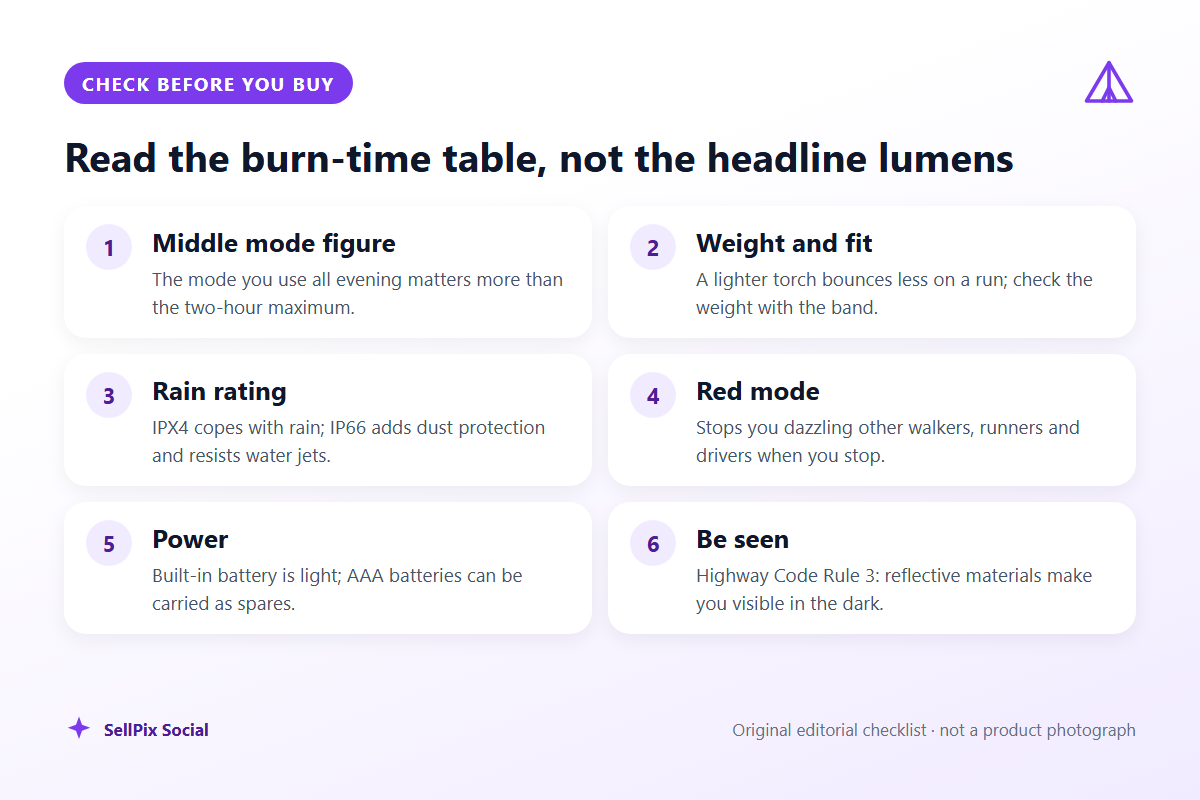
A head torch lights the ground in front of you. It is a poor way of being noticed by a driver coming from behind, and it can dazzle one coming towards you. The Highway Code's Rule 3 for pedestrians says to help other road users see you: wear something bright or fluorescent in poor daylight, and when it is dark, use reflective materials such as armbands, sashes, waistcoats, jackets or footwear, which drivers can see in their headlights up to three times as far away as non-reflective materials.
Petzl puts it plainly on its product pages: its lamps are not certified for road use and are not a substitute for required standardised lights. So budget for a reflective vest or band alongside the torch. If you walk on a road with no pavement, Rule 2 says to keep to the right-hand side so you can see oncoming traffic, and to cross well before a sharp right-hand bend so oncoming drivers can see you.
How to read lumens, distance and burn time
Many makers publish lighting figures measured to the ANSI/PLATO FL 1 protocol. Each mode gets three numbers: brightness in lumens, beam distance in metres and burn time in hours. The trap is that the big number on the box is the maximum mode, which rarely lasts long.
Petzl's published table for the TIKKA running on its three AAA batteries shows this well:
| Mode | Brightness | Distance | Burn time |
|---|---|---|---|
| Max burn time | 7 lumens | 10 m | 110 h |
| Standard | 100 lumens | 45 m | 12 h (plus 20 h reserve) |
| Max power | 350 lumens | 70 m | 2 h (plus 20 h reserve) |
| Red, continuous | 2 lumens | 5 m | 60 h |
The 350-lumen headline lasts two hours. The setting you would use for most of a long walk, 100 lumens reaching 45 m, runs for twelve, and then drops to a low reserve rather than going dark. When comparing torches, compare the mode you will actually use, not the maximum.
Running vs walking
Running on lit streets. Street lighting does most of the work; the torch fills in shadows, kerbs and uneven slabs. Weight and stability matter more than reach, because a heavy torch bounces with every stride.
Running on unlit lanes, towpaths and trails. Now the torch is your only light. You want enough distance to read the path ahead at running pace and a setting that lasts the whole run with some to spare.
Long winter walks. Pace is slower, so a wide, even beam near your feet is more useful than long throw. Burn time and a back-up plan matter most. A torch that runs on AAA batteries lets you carry spares in a pocket rather than relying on a single built-in battery.
Other things that matter in a British winter
- Rain. Petzl rates the TIKKA IPX4, which it describes as weather resistant. Nitecore rates the NU25 MCT UL IP66 for water and dust. Either should cope with a wet run or walk.
- Red light. A red mode lets you read a map or chat at a gate without dazzling the people you are with. Both torches in this guide have one.
- Weight. Nitecore lists the NU25 MCT UL at 47 g with bracket and headband; Petzl lists the TIKKA at 94 g. On a walk you will hardly notice the difference; on a run you may.
- Lock function. A lock stops the torch switching on in a bag and draining the batteries. Petzl lists one for the TIKKA.
- Light colour. Nitecore offers warm, neutral and cool white beams; warmer light is often easier on the eyes in rain or mist, though that is a matter of preference.
Buying decision
Choose the Nitecore NU25 MCT UL if you run, on lit streets or dark lanes, or simply want the lightest torch: Nitecore lists 47 g, up to 400 lumens with a 132 m throw, IP66, a red auxiliary light and a built-in 700 mAh battery charged over USB-C. Choose the Petzl TIKKA if you mostly walk, especially on long or remote outings: it runs on three AAA batteries that are included and easy to carry as spares, Petzl publishes a 12-hour burn time at 100 lumens on its standard setting, and it can take Petzl's CORE rechargeable battery later. Skip both if what you really need is to be seen on the road; buy reflective kit first.
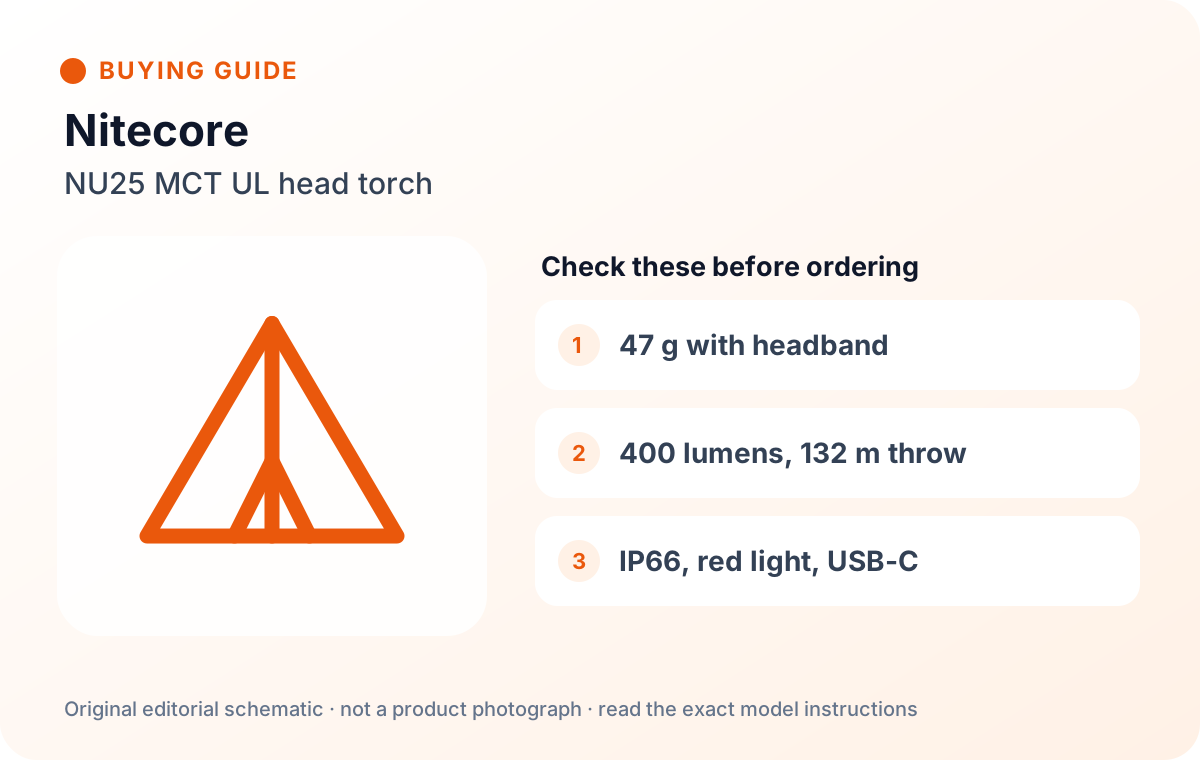
Nitecore NU25 MCT UL Headlamp, Black
An ultralight rechargeable head torch: Nitecore lists 47 g with bracket and headband, up to 400 lumens and a 132 m beam, IP66, red auxiliary lights and a choice of warm, neutral or cool white light.
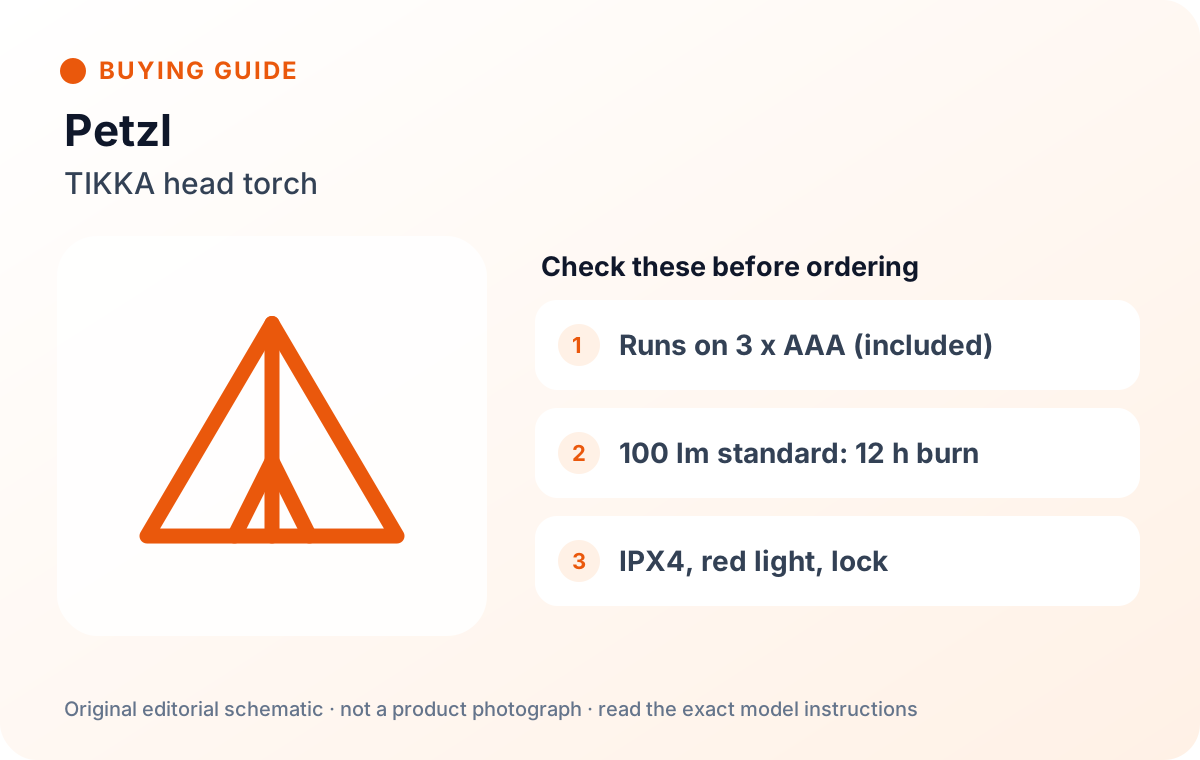
Petzl TIKKA Headlamp, 350 lumens, Blue
A compact AAA head torch with a wide, even beam. Petzl rates it at 350 lumens and 94 g, publishes a 12-hour burn time at 100 lumens, and it can also take Petzl's CORE rechargeable battery.
| Nitecore NU25 MCT UL | Petzl TIKKA | |
|---|---|---|
| Maximum output | 400 lumens (maker) | 350 lumens on AAA (maker, ANSI/PLATO FL 1) |
| Maximum distance | 132 m (maker) | 70 m (maker) |
| Weight | 47 g with bracket and headband | 94 g |
| Power | Built-in 700 mAh Li-ion, USB-C | 3 x AAA included; optional CORE rechargeable |
| Water rating | IP66 | IPX4 |
| Red light | Auxiliary red, two levels | Red continuous and strobe |
| Best for | Running, minimal bounce | Long walks, spare batteries |
Before you order
- Check the Nitecore model name says NU25 MCT UL: Nitecore also sells an older NU25, an NU25 UL and a standard NU25 MCT.
- Petzl sells the TIKKA in several colours and a separate TIKKA CORE (rechargeable) model; this link is the 350-lumen TIKKA that runs on AAA.
- If you choose the TIKKA, buy spare AAA batteries; Petzl lists alkaline, lithium and Ni-MH as compatible.
- Pack a reflective vest, band or jacket; the Highway Code points to reflective materials for being seen in the dark.
- If you run in a group on roads, agree on red mode when stopped so you do not dazzle each other.
FAQ
How many lumens do I need for running at night?
On lit streets, a few hundred lumens at most, mostly used on a lower setting. On unlit paths you will use more, so check how long the middle mode lasts rather than the maximum.
Is a head torch enough to be seen by drivers?
No. The Highway Code recommends reflective materials in the dark, which drivers can see in their headlights up to three times as far away as non-reflective ones. Petzl also says its lamps are not a substitute for required road lights.
Rechargeable or AAA?
A built-in battery keeps weight down and is easy to top up after every run. AAA batteries suit long walks because you can carry spares. The TIKKA takes either AAA or Petzl's optional CORE rechargeable pack.
Do I need a waterproof head torch for UK winters?
You need one that copes with rain. IPX4 (weather resistant) is enough for running and walking; IP66 adds dust protection and resistance to powerful water jets.
Which side of the road should I walk on in the dark?
If there is no pavement, Highway Code Rule 2 says to keep to the right-hand side so you can see oncoming traffic, and to cross before a sharp right-hand bend.
How we researched this
We read the Highway Code's rules for pedestrians on GOV.UK, Petzl's TIKKA and ACTIK CORE pages including their ANSI/PLATO FL 1 tables, and Nitecore's NU25 MCT UL specifications on 10 October 2026, and checked both Amazon.co.uk listings the same day. We first shortlisted the Petzl ACTIK CORE, but the Amazon.co.uk listings we found described an older 450-lumen version while Petzl's current page lists 625 lumens, so we chose the TIKKA, whose listing matches Petzl's page. A Black Diamond AAA torch was dropped because we could not open its maker's specifications. We did not run or walk with these torches; the running-versus-walking advice is editorial judgement based on the maker figures. Buying links and any commission relationship are disclosed on this page.