'/%3e%3cpath%20d='M31%2038c0-8%206-14%2014-14h38c8%200%2014%206%2014%2014v52c0%208-6%2014-14%2014H45c-8%200-14-6-14-14V38z'%20fill='url(%23tmPanel)'%20filter='url(%23tmShadow)'/%3e%3cpath%20d='M44%2044h40'%20fill='none'%20stroke='%23f97316'%20stroke-width='8'%20stroke-linecap='round'/%3e%3cpath%20d='M44%2061h24'%20fill='none'%20stroke='%23fdba74'%20stroke-width='8'%20stroke-linecap='round'/%3e%3cpath%20d='M43%2087l13-14%2011%2010%2017-21%202%2025H43z'%20fill='%23fb923c'/%3e%3ccircle%20cx='84'%20cy='58'%20r='6'%20fill='%23f97316'/%3e%3cpath%20d='M77%2091l16-18%2014%2014'%20fill='none'%20stroke='%2316a34a'%20stroke-width='7'%20stroke-linecap='round'%20stroke-linejoin='round'/%3e%3cpath%20d='M99%2074h-6v-6'%20fill='none'%20stroke='%2316a34a'%20stroke-width='7'%20stroke-linecap='round'%20stroke-linejoin='round'/%3e%3cpath%20d='M30%2034c8-10%2020-15%2034-15s26%205%2034%2015'%20fill='none'%20stroke='%23fff7ed'%20stroke-width='5'%20stroke-linecap='round'%20opacity='.92'/%3e%3cpath%20d='M27%2096c9%208%2021%2012%2037%2012s28-4%2037-12'%20fill='none'%20stroke='%23fff7ed'%20stroke-width='5'%20stroke-linecap='round'%20opacity='.72'/%3e%3c/svg%3e)
Dehumidifier for condensation and damp in a UK home: compressor or desiccant?
How to choose a dehumidifier for condensation in a UK flat or house: why compressor models suit heated rooms and desiccant models suit cold ones, how to compare litres-per-day figures that are measured at different test conditions, how to work out running cost from wattage, and when damp is a repair for the landlord rather than a job for a gadget.
Quick answer: In a flat or house you keep heated to normal living temperature, a compressor dehumidifier such as the MeacoDry Arete One 10L removes water for the least electricity. In a cold room you do not heat (a spare bedroom, boxroom or garage), a desiccant model such as the EcoAir DD1 Classic keeps working where compressors slow down, but it draws more power. A dehumidifier treats condensation; it does not fix leaks, rising damp or penetrating damp, which are building repairs.
First: is it condensation or a building fault?
GOV.UK's guidance on damp and mould describes condensation as the most common form of damp: moisture from cooking, showering, drying washing and breathing settles on cold surfaces such as window frames, wall corners and walls behind furniture. The Energy Saving Trust says a typical household produces up to 100 litres of moisture a week, and that if you have no leaks or rising damp, the problem is almost certainly condensation.
The same GOV.UK guidance names three other kinds of damp: penetrating damp (water getting in through walls, roofs, windows or floors), rising damp (moisture from the ground, often misdiagnosed and best confirmed by testing) and traumatic damp (leaks, burst pipes, floods). These are building faults. If you rent, GOV.UK says landlords are responsible for dealing with damp and mould, should act promptly, and should fix the underlying cause rather than just remove surface mould. A dehumidifier will not dry out a leaking roof. Signs that point away from condensation include a tidemark along the bottom of a wall (rising damp, per the Energy Saving Trust) or a damp patch that gets worse when it rains (penetrating damp).
GOV.UK lists children, older people, pregnant women and people with asthma, COPD or weakened immune systems among those at higher risk from damp and mould, and advises seeing a healthcare professional if you have symptoms. A dehumidifier is not a treatment; the aim is a drier home.
A dehumidifier is one part of the fix
Before buying, do the free things. The Energy Saving Trust suggests covering pans, drying clothes outside when you can, wiping condensation off windows and shower walls, keeping trickle vents open, opening windows for at least five minutes several times a day, running extractor fans for at least 15 minutes after a shower or cooking, and leaving gaps between furniture and walls. It also says rooms where the heating is off or low in winter are prone to damp. It suggests considering a dehumidifier for excessive moisture or for drying washing indoors. That is the sensible role: a dehumidifier helps most where you cannot ventilate enough, such as a bedroom on winter nights or a flat where washing has to dry indoors.
Compressor or desiccant: the decision that matters
A compressor (refrigerant) dehumidifier cools air over a cold coil so water condenses out, like a small fridge. It works best in warm, humid air and slows down as the room gets colder. A desiccant dehumidifier passes air over a water-absorbing material and uses a heater to dry it out again, so its extraction depends much less on room temperature, but the heater makes it draw more power.
The makers' own figures show this clearly. Meaco publishes extraction at several conditions for the Arete One 10L: 4.34 litres a day at 20°C and 60% relative humidity, but only 1.41 litres a day at 10°C and 60%. The EcoAir listing gives the DD1 Classic at 7.5 litres a day at 20°C and 60%, and EcoAir states it can extract up to 7.5 litres at temperatures as low as 1°C (a maker claim without a published low-temperature test). Meaco lists an operating range of 5 to 35°C for the Arete One; the EcoAir listing gives 1 to 40°C.
So the rule of thumb: if the room is heated to normal living temperature most of the time, a compressor model does the job on less electricity. If the room is cold (heating off overnight, an unheated boxroom, a garage), a desiccant model keeps extracting.
How to read litres-per-day figures
Headline litres-per-day numbers are measured at test conditions chosen by the maker, and they are not comparable unless the conditions match. Meaco's "10L" model name comes from its figure at 30°C and 80% humidity (10.42 litres a day), conditions a British flat rarely reaches. At 20°C and 60%, a more typical indoor reading, Meaco lists 4.34 litres a day. Always look for the temperature and humidity printed next to the figure. If a listing gives only "up to X litres a day", treat it as a best case.
Working out the running cost
You do not need anyone's pence-per-hour claim. Use the rated watts from the listing or manual and the unit rate on your own electricity bill:
- Divide the watts by 1000 to get kilowatts.
- Multiply by the hours it runs to get kilowatt hours (kWh).
- Multiply the kWh by your unit rate.
Ofgem explains that the unit rate is what you pay for each kWh of electricity and that the price cap limits the unit rate and standing charge, not your total bill. Worked in kWh: the Meaco listing gives 151 W, so eight hours is about 1.2 kWh; the EcoAir listing gives 300 W, so eight hours is 2.4 kWh. Multiply each by your unit rate. These are ceilings: both machines cycle down once the room reaches the humidity you set (Meaco's humidistat runs from 40 to 70%; EcoAir's Eco mode switches between full power, economy and standby, and its fan-only mode draws 25 W according to the listing).
At the same 20°C and 60% test condition, the figures work out similar per kWh: roughly 1.2 litres per kWh for the Meaco (4.34 litres from about 3.6 kWh a day) and roughly 1 litre per kWh for the EcoAir (7.5 litres from 7.2 kWh a day). The EcoAir removes more water per day there, but it does it by using about twice the power. In a cold room the balance shifts towards the desiccant, because the compressor's extraction falls away.
Other features worth paying for
- Tank size and drainage. Meaco lists a 2.5 L tank for the Arete One; the EcoAir comparison table on its listing gives 2 L for the DD1 Classic. Both can drain continuously through a hose (the EcoAir includes one; Meaco says the hose is not included).
- Laundry mode. Both have one. The Meaco listing says its laundry mode runs for six hours and then switches itself off.
- Noise and night use. Meaco lists 35 and 38 dB(A), and its Amazon.co.uk listing mentions a night mode; EcoAir lists 34 dB(A) in its quiet mode and 47 dB(A) at its highest setting. Electrical Safety First advises against running a dehumidifier overnight or while you are out unless the maker says it is safe unattended, so check the manual before using either in a bedroom at night.
- Air purifying extras. The Meaco includes an H13 HEPA filter; the EcoAir has an ioniser and a silver filter. Neither is a reason to choose a type on its own.
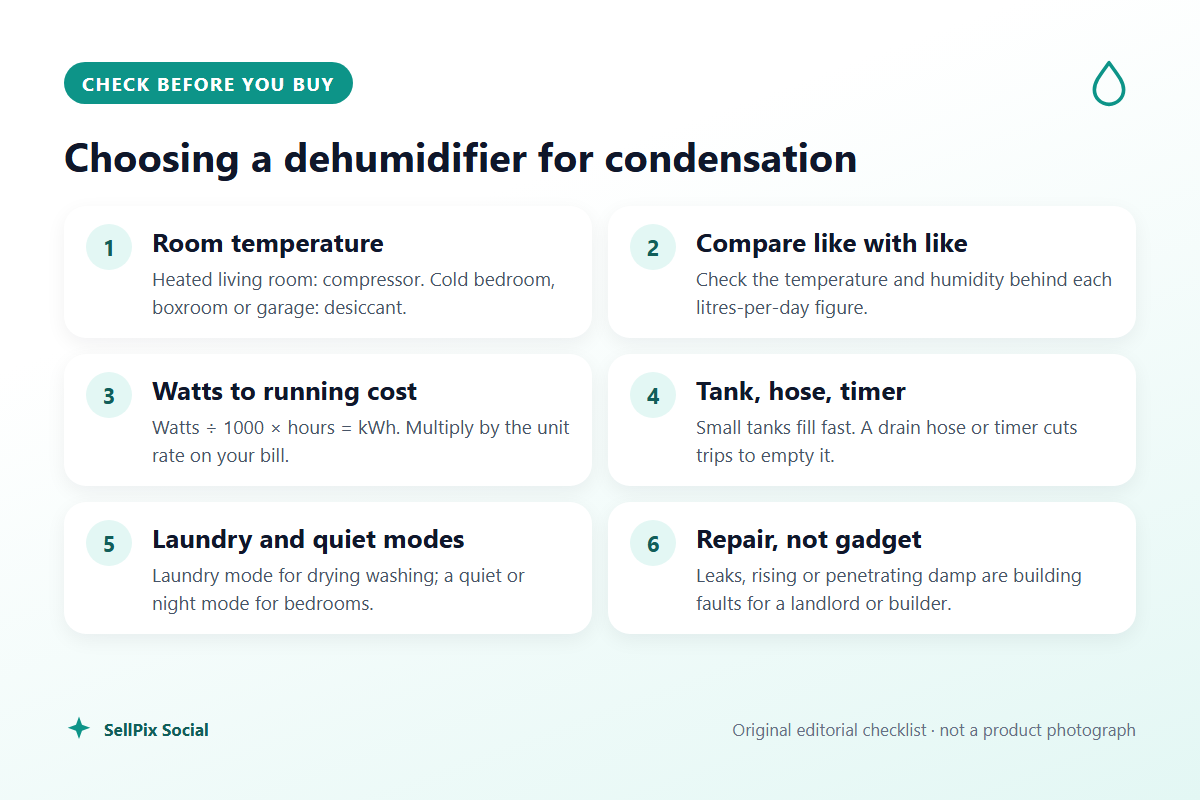
Buying decision
- Choose a compressor model such as the MeacoDry Arete One 10L if the room is heated to normal living temperature, you want the lowest power draw (151 W on the listing), and you value a 5-year warranty and a HEPA filter.
- Choose a desiccant model such as the EcoAir DD1 Classic if the room is cold for long periods, you want something light to carry between rooms (6 kg on the listing) and you accept a higher draw (300 W on the listing).
- Skip both and call the landlord or a builder if the damp is a tidemark at the bottom of a wall, a patch that grows when it rains, or anything caused by a leak.
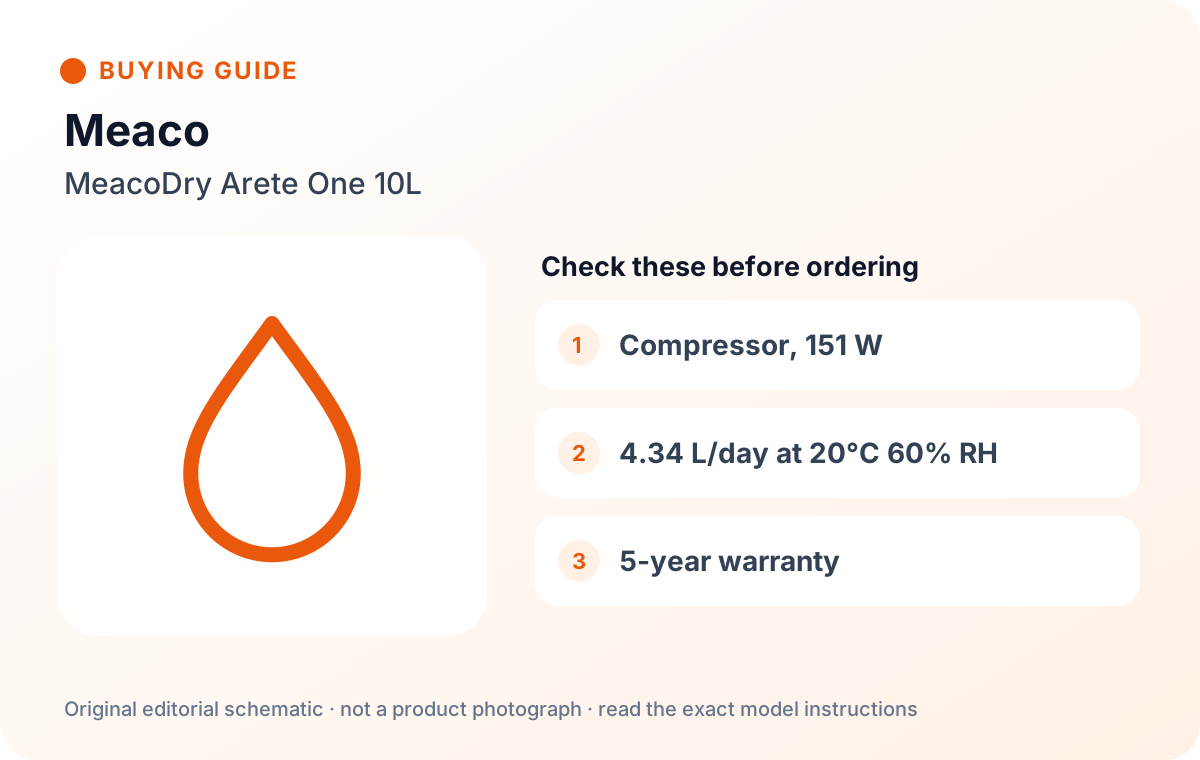
MeacoDry Arete One 10L Dehumidifier and HEPA Air Purifier
A small compressor dehumidifier with an H13 HEPA filter, laundry and night modes and a 2.5 L tank. Meaco publishes extraction at six test conditions, from 1.41 L/day at 10°C to 10.42 L/day at 30°C and 80% humidity; the listing gives 151 W.
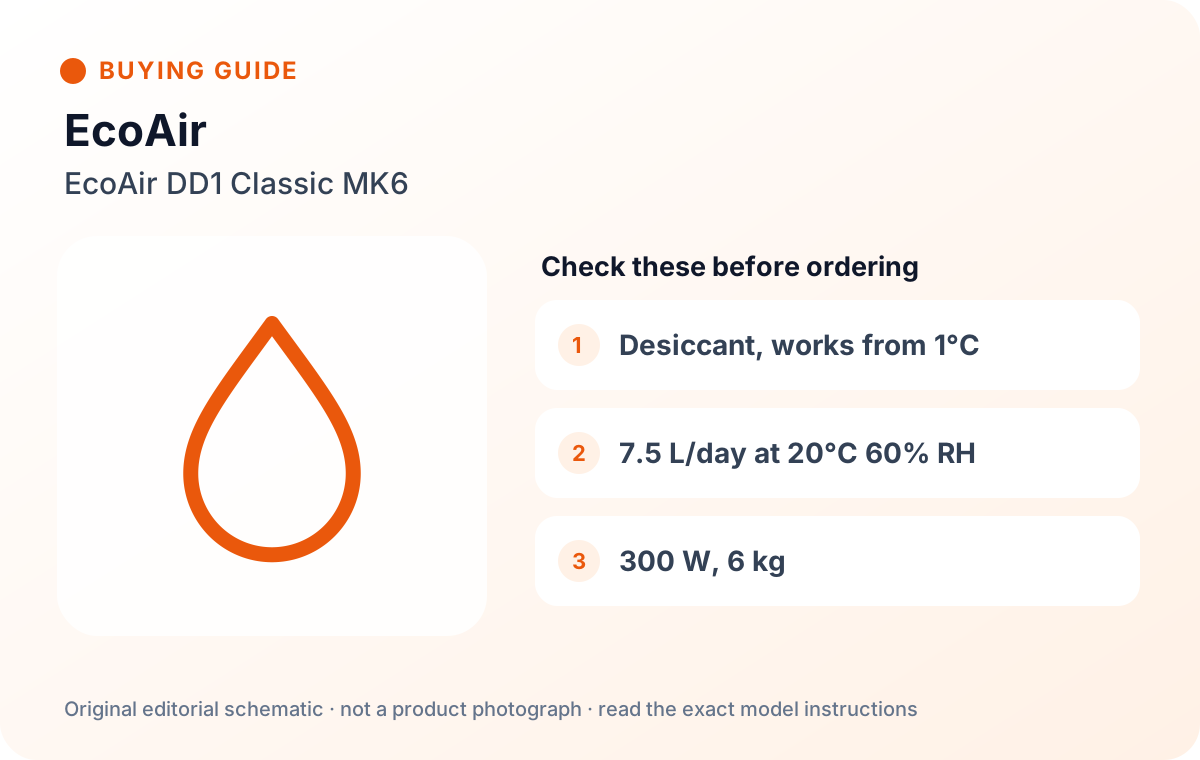
EcoAir DD1 Classic MK6 Black Desiccant Dehumidifier, 7.5 L/Day
A light desiccant dehumidifier for cold rooms, listed at 7.5 litres a day at 20°C and 60% humidity, 300 W, a 2 L tank, laundry and quiet modes, a 2, 4 or 8-hour timer and an included drainage hose.
| MeacoDry Arete One 10L | EcoAir DD1 Classic MK6 | |
|---|---|---|
| Type | Compressor (Meaco) | Desiccant |
| Extraction at 20°C / 60% RH | 4.34 L/day (Meaco) | 7.5 L/day (listing) |
| Extraction in cold rooms | 1.41 L/day at 10°C / 60% RH (Meaco) | Up to 7.5 L/day at temperatures as low as 1°C (maker claim) |
| Rated power | 151 W (listing; Meaco gives 129 to 199 W by condition) | 300 W (listing) |
| Operating range | 5 to 35°C (Meaco) | 1 to 40°C (listing) |
| Tank | 2.5 L | 2 L |
| Continuous drainage | Yes, hose not included | Yes, hose included |
| Noise | 35 / 38 dB(A) | 34 / 47 dB(A) |
| Weight | 10.7 kg (Meaco) | 6 kg (listing) |
| Warranty | 5 years (Meaco) | Check listing / EcoAir |
Before you order
- Measure or estimate the room temperature in winter where the machine will run. If it often sits around 10°C, favour desiccant: Meaco's own figure for its compressor model falls to 1.41 litres a day at 10°C.
- Check the exact model: Arete One 10L (Meaco also sells 6, 12, 20 and 25 L sizes and an app-enabled Arete Two), and DD1 Classic (EcoAir also sells the DD1 Simple, DD1 Mini and DD2 ranges; older stock may say MK5 or DD122).
- Check it has a UK 3-pin plug, comes from an established seller, and register it with the maker for safety recalls, as Electrical Safety First advises.
- Plan where water will go: a 2 to 2.5 L tank needs emptying often in a damp flat, so a nearby sink or floor drain for a hose helps.
- Keep the receipt and check the return window in case it is too loud for a bedroom.
FAQ
Will a dehumidifier get rid of black mould?
It reduces the humidity that lets mould grow, but it does not remove mould that is already there. The Energy Saving Trust advises using an antifungal or mould-removal product with gloves, a mask and a disposable cloth, and wiping mould only when it is wet. If you rent, GOV.UK says the landlord should deal with the cause.
What humidity should I set?
Meaco's humidistat runs from 40 to 70%. Start in the middle of that range and lower it if condensation still forms on windows in the morning. Neither GOV.UK nor the Energy Saving Trust pages we read give a single target figure.
Is a desiccant dehumidifier expensive to run?
It draws more power than a compressor model: 300 W against 151 W on these two listings. Work it out as watts ÷ 1000 × hours × your unit rate. In a cold room the extra cost buys extraction a compressor model would struggle to match.
Can I use one to dry washing indoors?
Yes, both have a laundry mode, and the Energy Saving Trust mentions dehumidifiers for drying washing indoors. Close the door and window of the room so it is not trying to dry the outside air.
Should my landlord pay for a dehumidifier?
GOV.UK says landlords are legally responsible for damp and mould whatever the cause and should fix the underlying problem. A dehumidifier is not a substitute for repairs. If a landlord does not act, the guidance points to the local council, which can inspect.
How we researched this
On 2026-10-10 we read GOV.UK's guidance on understanding and addressing the health risks of damp and mould in the home, the Energy Saving Trust's advice on damp, Electrical Safety First's dehumidifier advice, Ofgem's explanation of the price cap and unit rates, Meaco's product page for the Arete One 10L, and both Amazon.co.uk listings. We did not test either dehumidifier or measure extraction, noise or power. EcoAir's own website could not be opened when we checked, so EcoAir figures come from the Amazon.co.uk listing. The model we found on Amazon.co.uk is the DD1 Classic MK6, the newer version of the MK5. Buying links and any commission relationship are disclosed on this page.
Sources
- GOV.UK: Understanding and addressing the health risks of damp and mould in the home
- Energy Saving Trust: how to get rid of damp
- Electrical Safety First: dehumidifiers
- Ofgem: energy price cap and standing charges explained
- Meaco: MeacoDry Arete One 10L
- Amazon.co.uk listing, ASIN B09TBHGQXR
- Amazon.co.uk listing, ASIN B07N2TT512
Related guides
Ninja Foodi Dual Zone AF300UK vs Tower Vortx 9L dual basket air fryer: which should you buy?
Two dual-drawer air fryers sold widely in the UK, compared from the makers' own specifications and the Amazon.co.uk listings: what fits in each drawer, Sync and Match, viewing windows, worktop footprint, cleaning and warranty, plus what the Energy Saving Trust says about air fryer versus oven running costs.
Heated throw running costs in the UK: how to work them out, and Beurer HD 75 vs Silentnight Comfort Control
A heated throw's running cost is simple arithmetic: rated watts divided by 1000, times hours, times your unit rate. We show the method, explain why the result is a ceiling rather than a measurement, and compare two UK-plug throws on size, heat settings, auto switch-off, washing and what their listings actually publish, finishing with Electrical Safety First's safety checklist.

Filter jug for hard water: is it worth it, and which one should you buy?
What a filter jug does and does not do in a UK hard water area: less kettle scale and better-tasting tea, not a softened house. How to pick the cartridge first and the jug second, how many cartridges a year you will need, what fits a fridge door, and when to use plain tap water instead, including for baby formula.