'/%3e%3cpath%20d='M31%2038c0-8%206-14%2014-14h38c8%200%2014%206%2014%2014v52c0%208-6%2014-14%2014H45c-8%200-14-6-14-14V38z'%20fill='url(%23tmPanel)'%20filter='url(%23tmShadow)'/%3e%3cpath%20d='M44%2044h40'%20fill='none'%20stroke='%23f97316'%20stroke-width='8'%20stroke-linecap='round'/%3e%3cpath%20d='M44%2061h24'%20fill='none'%20stroke='%23fdba74'%20stroke-width='8'%20stroke-linecap='round'/%3e%3cpath%20d='M43%2087l13-14%2011%2010%2017-21%202%2025H43z'%20fill='%23fb923c'/%3e%3ccircle%20cx='84'%20cy='58'%20r='6'%20fill='%23f97316'/%3e%3cpath%20d='M77%2091l16-18%2014%2014'%20fill='none'%20stroke='%2316a34a'%20stroke-width='7'%20stroke-linecap='round'%20stroke-linejoin='round'/%3e%3cpath%20d='M99%2074h-6v-6'%20fill='none'%20stroke='%2316a34a'%20stroke-width='7'%20stroke-linecap='round'%20stroke-linejoin='round'/%3e%3cpath%20d='M30%2034c8-10%2020-15%2034-15s26%205%2034%2015'%20fill='none'%20stroke='%23fff7ed'%20stroke-width='5'%20stroke-linecap='round'%20opacity='.92'/%3e%3cpath%20d='M27%2096c9%208%2021%2012%2037%2012s28-4%2037-12'%20fill='none'%20stroke='%23fff7ed'%20stroke-width='5'%20stroke-linecap='round'%20opacity='.72'/%3e%3c/svg%3e)
Oral-B iO2 vs Philips Sonicare 3100: which entry-level electric toothbrush should you buy?
The NHS says manual and electric brushes are equally good if you clean every surface for about two minutes with fluoride toothpaste. So this comparison of two current entry-level brushes on Amazon.co.uk looks at what helps the habit: the feel of the brush, pressure warnings, timers, battery life, charging in a UK bathroom and which replacement heads you will be buying for years.
Quick answer: Both are sensible first electric toothbrushes with a pressure warning and a 2-minute timer. Choose the Oral-B iO2 if you want a small round head, the longest battery life (up to 4 weeks, says Oral-B) and a charger with a 2-pin plug that suits a bathroom shaver socket. Choose the Philips Sonicare 3100 (HX4033) if you prefer the gentler buzz of a sonic brush, want a prompt every 30 seconds and three intensity levels, and would rather charge from USB. The NHS is clear that the type of brush matters less than brushing well.
Start with what the NHS says
The NHS page on keeping your teeth clean says it does not matter whether you use an electric or a manual toothbrush: both are equally good, as long as you clean all the surfaces of all your teeth and use fluoride toothpaste. It advises brushing twice a day for about 2 minutes, using a toothpaste with at least 1,350ppm fluoride for adults, and spitting rather than rinsing afterwards so the fluoride stays on your teeth.
The Oral Health Foundation adds that research shows electric toothbrushes can slightly reduce plaque and gum inflammation compared with manual brushes, that some brushes pause every 30 seconds to remind you to move on, that a pressure warning helps because brushing too hard can damage teeth and gums, and that heads should be changed every three months or sooner if the bristles spread.
So an electric brush is a tool for the habit: a timer, a pressure warning and a feel you will put up with twice a day. Both makers also quote plaque-removal figures against a manual brush (Oral-B: 100% more; Philips: up to 5 times more). Those are the makers' own claims under their own test conditions, and we do not use them to pick a winner.
The differences that matter day to day
Feel: round head or sonic
The Oral Health Foundation describes two main types: oscillating-rotating brushes with a small round head, and sonic brushes that use fast vibrations. Oral-B describes the iO2 as combining gentle micro-vibrations with a round, dentist-inspired brush head. Philips' Sonicare 3100 is a sonic brush; the listing quotes 31,000 bristle movements and Philips' "Fluid Action". Neither is better for everyone. Some people like the tooth-by-tooth feel of a round head; others find a sonic brush gentler and less noisy. If you have tried a friend's brush and hated it, that is useful evidence.
Pressure warning
Both have one, and they work differently. Oral-B says the iO2's automatic gum pressure sensor slows the brush and signals red when you press too hard. Philips says the 3100's sensor makes the handle vibrate gently so you ease off. A visible light is easier to notice if you brush in front of a mirror; a vibration works with your eyes shut.
Timer and pacing
Both time a 2-minute clean. The Sonicare 3100 adds a prompt every 30 seconds (Philips calls it QuadPacer or BrushPacer) to move to the next quarter of your mouth, which matches the Oral Health Foundation's point about 30-second reminders. Oral-B's iO2 page and listing mention the 2-minute timer; check the manual if 30-second pacing matters to you.
Settings
The iO2 has three quiet intensity levels: Super Sensitive, Sensitive and Daily Clean. The Sonicare 3100 has High, Medium and Low, plus Easy Start, which Philips says builds the power up gradually over your first 14 cleans for people switching from a manual brush.
Battery and charging in a UK bathroom
Oral-B says the iO2 battery lasts up to 4 weeks on a single charge, and its UK in-the-box list includes a charger with a 2-pin plug. In many UK bathrooms that means a shaver socket; otherwise you need a 2-pin adaptor or to charge it elsewhere. Philips lists up to 14 days for the 3100 and a USB charger in the box, which is easier if you have no shaver socket, but check whether you need a USB wall plug. Both come with a travel case in the listings we checked.
Replacement heads
This is the cost you live with. Oral-B says iO handles take Oral-B iO heads only; older Pro, Vitality and Genius heads do not fit. Philips' Sonicare 3100 takes its click-on heads, and the HX4033 ships with a W Optimal White head. Oral-B and the Oral Health Foundation both say to change heads about every three months. Before you buy, check that you can easily get heads for your chosen system, and consider a multipack.
Buying decision
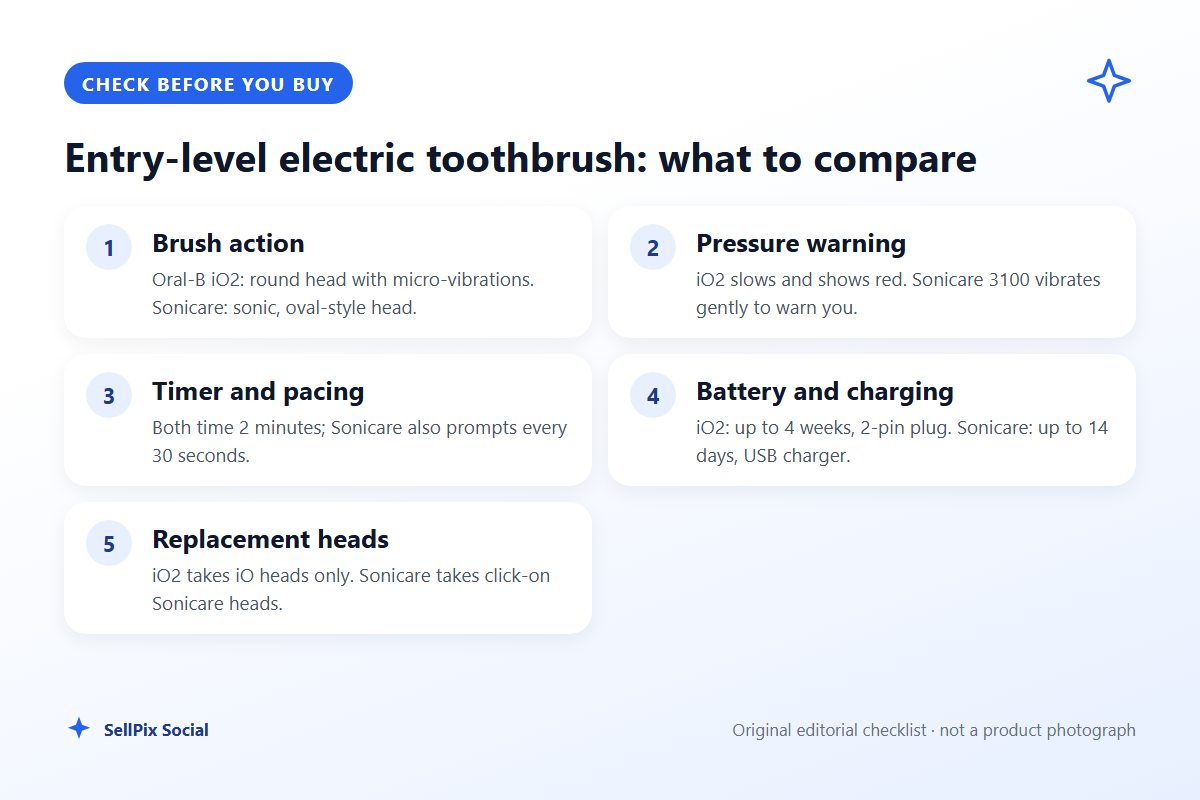
- Choose the Oral-B iO2 if you like a small round head, want a visible red pressure warning and the longest time between charges, and have a shaver socket or 2-pin adaptor in the bathroom.
- Choose the Philips Sonicare 3100 (HX4033) if you prefer a sonic brush, want 30-second prompts and an easy start for the first fortnight, and would rather charge from USB.
- Skip both if you already brush well with a manual brush and do not want ongoing head costs; the NHS says a manual brush is equally good when used properly. If you have sore or bleeding gums, see a dentist rather than relying on a new brush.
Oral-B iO2 Electric Toothbrush, Night Black, with Travel Case
Oral-B's entry iO model: a round head with gentle micro-vibrations, one button, three quiet intensity levels, an automatic pressure sensor that slows the brush and shows red, a 2-minute timer and a battery Oral-B rates at up to 4 weeks. This listing includes a travel case.
Philips Sonicare 3100 Series Electric Toothbrush - Sonic Toothbrush with Pressure Sensor, 3 Intensity Levels, EasyStart, SmarTimer, Travel Case, White, HX4033/21
The new-generation Sonicare 3100 (HX4033/21): a sonic brush with High, Medium and Low intensities, Easy Start, a pressure sensor that vibrates to warn you, a 2-minute SmarTimer with 30-second prompts and up to 14 days of battery. Philips lists a USB charger and a travel case in the box.
| Oral-B iO2 | Philips Sonicare 3100 (HX4033/21) | |
|---|---|---|
| Brush action | Round head, micro-vibrations (Oral-B) | Sonic; 31,000 bristle movements (listing) |
| Pressure warning | Slows and shows red | Gentle vibration |
| Timer | 2 minutes | 2 minutes plus 30-second prompts |
| Settings | Super Sensitive, Sensitive, Daily Clean | High, Medium, Low; Easy Start |
| Battery (maker) | Up to 4 weeks | Up to 14 days |
| Charger | 2-pin plug (Oral-B UK) | USB charger (Philips UK) |
| Heads | Oral-B iO heads only | Sonicare click-on heads |
| In the listing box | Handle, head, charger, travel case, head holder | Handle, W Optimal White head, charger, travel case |
Before you order
- Check the model: iO2 (not iO3 or above) and HX4033 for the new-generation Sonicare 3100. Older 3100 listings (HX3671) are a previous design.
- Decide where you will charge: shaver socket for the iO2's 2-pin plug, or a USB plug for the Sonicare.
- Look up replacement heads for the system before you buy; iO and Sonicare heads are not interchangeable with other ranges.
- Keep using a fluoride toothpaste of at least 1,350ppm, as the NHS advises for adults.
- If you share a bathroom, choose different handle or head colours so brushes do not get mixed up.
FAQ
Is an electric toothbrush better than a manual one?
The NHS says both are equally good if you clean every surface for about 2 minutes with fluoride toothpaste. The Oral Health Foundation notes research showing electric brushes can slightly reduce plaque and gum inflammation. The timer and pressure warning are the practical benefits.
Can I use Oral-B Pro heads on the iO2?
No. Oral-B says iO handles take iO heads only, and older models take the Pro range.
How often should I replace the head?
About every three months, or sooner if the bristles spread out, according to the Oral Health Foundation. The Sonicare 3100 has a battery light; check the manual for any head reminder.
Can I charge the iO2 in a UK bathroom?
Its charger has a 2-pin plug, which suits a bathroom shaver socket. Without one, use a suitable 2-pin adaptor in another room.
Which is quieter?
Oral-B describes the iO2 as quiet, with quiet intensity levels. Philips does not publish a noise figure for the 3100. We did not measure either.
How we researched this
On 2026-10-10 we read the NHS page on keeping teeth clean, the Oral Health Foundation's guide to electric toothbrushes, Oral-B UK's iO2 product page and Philips UK's specification for the Sonicare 3100 HX4033/21, and checked both Amazon.co.uk listings. We first planned to compare the Oral-B Pro 3 3000 with the older Sonicare 3100 HX3671, but Oral-B UK no longer lists the adult Pro 3, Philips UK lists the HX3671 for support only, and on that date both were offered on Amazon.co.uk only by third-party sellers, so we compared the current entry models. We did not test either brush, and plaque-removal figures are reported only as the makers' claims. Buying links and any commission relationship are disclosed on this page.