'/%3e%3cpath%20d='M31%2038c0-8%206-14%2014-14h38c8%200%2014%206%2014%2014v52c0%208-6%2014-14%2014H45c-8%200-14-6-14-14V38z'%20fill='url(%23tmPanel)'%20filter='url(%23tmShadow)'/%3e%3cpath%20d='M44%2044h40'%20fill='none'%20stroke='%23f97316'%20stroke-width='8'%20stroke-linecap='round'/%3e%3cpath%20d='M44%2061h24'%20fill='none'%20stroke='%23fdba74'%20stroke-width='8'%20stroke-linecap='round'/%3e%3cpath%20d='M43%2087l13-14%2011%2010%2017-21%202%2025H43z'%20fill='%23fb923c'/%3e%3ccircle%20cx='84'%20cy='58'%20r='6'%20fill='%23f97316'/%3e%3cpath%20d='M77%2091l16-18%2014%2014'%20fill='none'%20stroke='%2316a34a'%20stroke-width='7'%20stroke-linecap='round'%20stroke-linejoin='round'/%3e%3cpath%20d='M99%2074h-6v-6'%20fill='none'%20stroke='%2316a34a'%20stroke-width='7'%20stroke-linecap='round'%20stroke-linejoin='round'/%3e%3cpath%20d='M30%2034c8-10%2020-15%2034-15s26%205%2034%2015'%20fill='none'%20stroke='%23fff7ed'%20stroke-width='5'%20stroke-linecap='round'%20opacity='.92'/%3e%3cpath%20d='M27%2096c9%208%2021%2012%2037%2012s28-4%2037-12'%20fill='none'%20stroke='%23fff7ed'%20stroke-width='5'%20stroke-linecap='round'%20opacity='.72'/%3e%3c/svg%3e)
Lumie Bodyclock Shine 300 vs Philips Wake-up Light HF3531: which sunrise alarm suits dark mornings?
Two mains-powered sunrise alarm clocks for the bedside, compared on the things that change daily use: how long the sunrise can run, the wind-down sunset, sounds and radio, extras such as a reading lamp, and what each maker actually publishes about brightness. A wake-up routine comparison, not a health product review.
Quick answer: Choose the Lumie Bodyclock Shine 300 if you want a long, slow sunrise (up to 90 minutes), an equally long bedtime sunset and plenty of sleep sounds. Choose the Philips SmartSleep Wake-up Light HF3531 if a 20 to 40-minute coloured sunrise is enough and you would use its extras: two alarm times, tap snooze, a reading lamp, a dim midnight light and a USB port for your phone. Philips also publishes a brightness figure (300 lux). Both are bedside wake-up lamps, not light-therapy boxes.
What a sunrise alarm does, and what it does not do
A sunrise alarm clock brightens gradually before your alarm time, so the bedroom is already light when the sound (if any) starts. In a UK winter, when it can still be dark at 7am, that is the whole appeal: you wake to light rather than to a buzzer in a black room. Both lamps here also run a "sunset" that dims slowly at bedtime, for people who like to read and then let the light fade.
Keep expectations practical. The NHS Every Mind Matters sleep page recommends going to bed and waking up at around the same time each day and giving yourself time to wind down; a lamp can make a regular routine easier to stick to, but it is not a treatment. These are also not the same thing as a light box. The NHS page on seasonal affective disorder says light therapy is not usually available on the NHS because there is not enough evidence to tell whether it works, advises talking to a GP first, and says a light box should be around 10,000 lux. A bedside wake-up lamp is far dimmer than that. Both listings make wellbeing claims; we do not repeat them. If you are worried about low mood in winter, speak to your GP rather than buying a lamp to fix it.
The four differences that decide it
1. How long the sunrise lasts
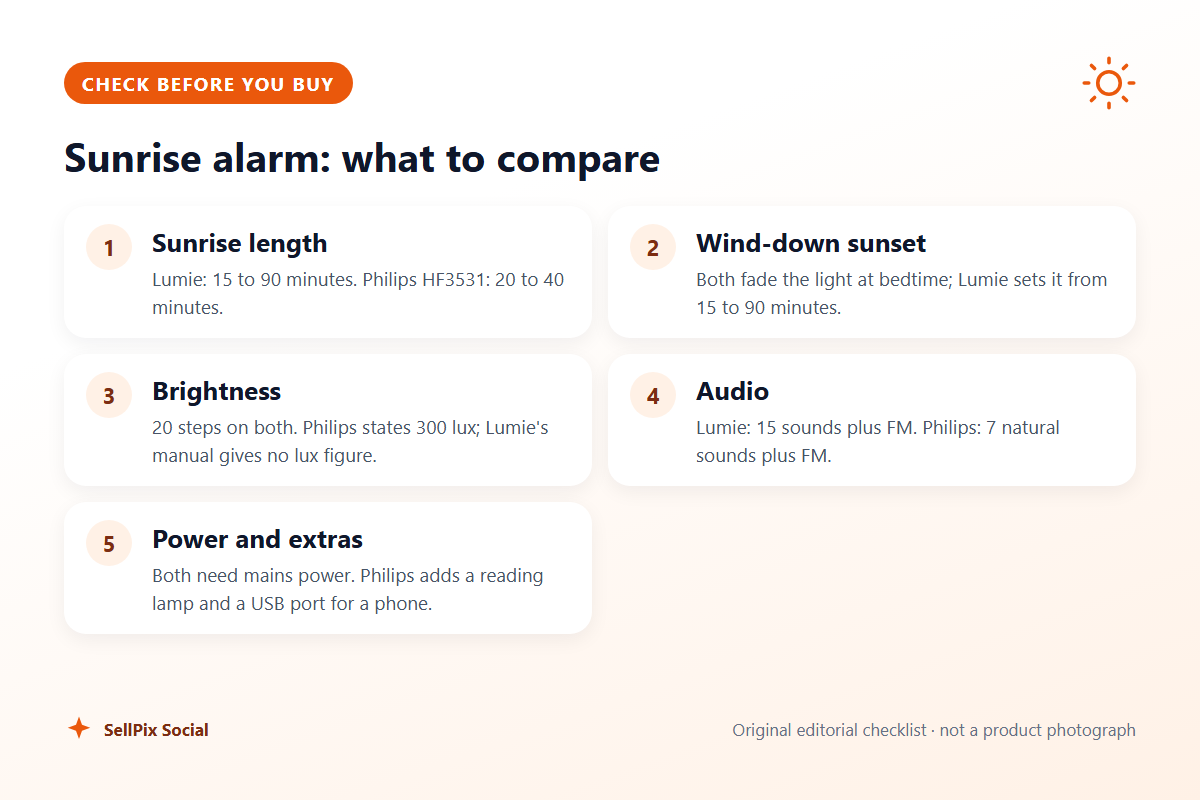
This is the clearest split. Lumie's Shine 300 manual lets you set the sunrise to off or anywhere from 15 to 90 minutes (the default is 30). Philips lists the HF3531 sunrise as adjustable from 20 to 40 minutes. If you like a very gentle 60 or 90-minute dawn, only the Lumie does it. If you just want the room light by the time the alarm goes, 20 to 40 minutes is plenty.
2. The bedtime sunset
Both fade the light at night. Lumie's sunset runs from 15 to 90 minutes, can end in darkness or at a dim nightlight level (1 to 10), and can play a sleep sound or the radio that fades out with it. Philips lists a dusk simulation with nature sounds on the HF3531 but does not give a sunset length range on its specification sheet, so check the manual if a long sunset matters to you.
3. Brightness: what is actually published
Both lamps have 20 brightness steps (on the Lumie you choose the final sunrise brightness from 1 to 20). Only Philips publishes a light output: its UK specification for HF3531/01 lists a light intensity of 300 lux. Lumie's English manual for the Shine 300 does not state a lux figure, so we do not quote one. Treat any lux number you see elsewhere with care, because it depends on the measuring distance.
4. Sounds, radio and extras
The Shine 300 has 15 built-in sleep and wake sounds (from birdsong to white noise) plus FM radio with 5 presets, and you can choose light only, a sound or the radio at the end of the sunrise. The HF3531 has 7 natural sounds plus FM radio, two alarm times and tap snooze: tap the top and the sound pauses for 9 minutes. The Lumie snooze also repeats after 9 minutes. Philips adds a reading lamp, a "midnight light" (a soft light to find your way in the dark) and, according to the Amazon listing and Philips' specification, can charge a phone from a USB port. Both displays dim themselves in a dark room.
Power, plug and placement
Both lamps run from a mains adaptor rather than a built-in battery. Philips lists a 16.5 W rating, a 150 cm cord and a time back-up of 4 to 8 hours; Lumie's manual says the Shine 300 keeps time for 30 minutes without power and saves all other settings. Neither is a travel clock. Place it on the bedside table facing you, near a socket; a sunrise only helps if the light reaches your eyes. Philips describes its lamp as UV-free and not for general illumination, and Lumie's manual asks you not to cover the unit because it gets warm.
Buying decision
- Choose the Lumie Bodyclock Shine 300 if you want the longest and most adjustable sunrise and sunset (15 to 90 minutes each), a nightlight at the end of the sunset, and a wide choice of sleep sounds. It is the better fit if you wake slowly or want a very gradual change.
- Choose the Philips Wake-up Light HF3531 if a 20 to 40-minute coloured sunrise (red through orange to yellow, as Philips describes it) is enough and you want the extras: two alarm times, tap snooze, a reading lamp, a midnight light and a USB port for your phone.
- Skip both if you mainly want a light box for daytime use, if you need a battery-powered alarm for early shifts, or if you do not have a free socket beside the bed.
Lumie Bodyclock Shine 300 - Wake-up Light Alarm Clock with Radio, 15 Sounds and Sleep Sunset, White
A bedside sunrise alarm with the longest adjustable sunrise and sunset in this comparison (15 to 90 minutes each, per Lumie's manual), 20 brightness levels, 15 sleep and wake sounds and FM radio with 5 presets.
Philips SmartSleep Wake-up Light, Coloured Sunrise and Sunset Simulation, 7 Natural Sounds, FM Radio & Reading Lamp, Tap Snooze (HF3531/01)
A bedside wake-up light with a coloured sunrise of 20 to 40 minutes, a dusk fade with sounds, 20 brightness settings, 7 natural sounds, FM radio, two alarms, tap snooze, a reading lamp, a midnight light and a USB port for phone charging. Philips UK lists its light intensity as 300 lux.
| Lumie Bodyclock Shine 300 | Philips Wake-up Light HF3531/01 | |
|---|---|---|
| Sunrise length | Off or 15–90 min (manual) | 20–40 min (Philips UK spec) |
| Sunset | 15–90 min, fades to off or nightlight | Dusk simulation; length not stated in spec |
| Brightness steps | 1–20 final brightness | 20 settings |
| Published light output | Not stated in manual | 300 lux (Philips UK spec) |
| Sounds | 15 sleep/wake sounds | 7 natural sounds |
| Radio | FM, 5 presets | FM |
| Snooze | Repeats after 9 min | Tap snooze, 9 min |
| Alarms | Daily or weekly schedule | 2 alarm times |
| Extras | Nightlight at end of sunset | Reading lamp, midnight light, USB phone charging |
| Without power | Keeps time 30 min (manual) | Time back-up 4–8 h (spec) |
| Maker warranty | 3 years (manual) | Check listing / Philips |
Before you order
- Check the exact model: Shine 300 (not the Shine 200 or Bodyclock Luxe) and HF3531/01 (not the cheaper HF3519, the older HF3520 or the app-connected models).
- Both need a mains socket beside the bed; confirm the listing photos show a UK plug or UK adaptor.
- If you want a very long sunrise or sunset, that points to the Lumie; Philips tops out at 40 minutes for the sunrise.
- Keep the box and check the seller's return window, because how a sunrise feels is personal.
- Register the product with the maker so you hear about any safety notices.
FAQ
Is a sunrise alarm clock the same as a SAD lamp?
No. A wake-up lamp is a bedside lamp that brightens slowly before your alarm. The NHS says a light box for seasonal affective disorder should be around 10,000 lux and advises speaking to a GP first. Philips lists the HF3531 at 300 lux. Buy these lamps to make waking easier, not as a treatment.
Which one has the longer sunrise?
The Lumie. Its manual allows 15 to 90 minutes; Philips lists 20 to 40 minutes for the HF3531.
Can I wake to light only, with no sound?
On the Lumie, yes: its manual lets you set the alarm source to off, a sound or the radio. Philips lists waking with light as a feature and offers its sounds or the radio for the alarm; check the HF3531 manual for how to turn the sound off completely.
Will either work during a power cut?
Neither runs its light or alarm without mains power. Lumie says the Shine 300 keeps time for 30 minutes and saves its settings; Philips lists a 4 to 8-hour time back-up for the HF3531. If you cannot risk oversleeping, keep a battery alarm or your phone as a backup.
Does brightness matter if both have 20 steps?
The number of steps only tells you how finely you can adjust it. Philips publishes 300 lux for the HF3531; Lumie does not publish a lux figure in its manual. What matters most is that the lamp faces you and the final level feels bright enough without being harsh.
How we researched this
On 2026-10-10 we read Lumie's Bodyclock Shine 300 instruction manual (Lumie's own PDF), Philips UK's product page and published specification for the SmartSleep Wake-up Light HF3531/01, the NHS Every Mind Matters sleep page and the NHS seasonal affective disorder page, and checked both Amazon.co.uk listings. We first planned to compare the Philips HF3520, but could not find it as a lamp listing on Amazon.co.uk on that date, so we compared the HF3531, which Philips UK still lists. We did not buy or test either lamp, did not measure brightness, and do not repeat the makers' wellbeing claims. Buying links and any commission relationship are disclosed on this page.