'/%3e%3cpath%20d='M31%2038c0-8%206-14%2014-14h38c8%200%2014%206%2014%2014v52c0%208-6%2014-14%2014H45c-8%200-14-6-14-14V38z'%20fill='url(%23tmPanel)'%20filter='url(%23tmShadow)'/%3e%3cpath%20d='M44%2044h40'%20fill='none'%20stroke='%23f97316'%20stroke-width='8'%20stroke-linecap='round'/%3e%3cpath%20d='M44%2061h24'%20fill='none'%20stroke='%23fdba74'%20stroke-width='8'%20stroke-linecap='round'/%3e%3cpath%20d='M43%2087l13-14%2011%2010%2017-21%202%2025H43z'%20fill='%23fb923c'/%3e%3ccircle%20cx='84'%20cy='58'%20r='6'%20fill='%23f97316'/%3e%3cpath%20d='M77%2091l16-18%2014%2014'%20fill='none'%20stroke='%2316a34a'%20stroke-width='7'%20stroke-linecap='round'%20stroke-linejoin='round'/%3e%3cpath%20d='M99%2074h-6v-6'%20fill='none'%20stroke='%2316a34a'%20stroke-width='7'%20stroke-linecap='round'%20stroke-linejoin='round'/%3e%3cpath%20d='M30%2034c8-10%2020-15%2034-15s26%205%2034%2015'%20fill='none'%20stroke='%23fff7ed'%20stroke-width='5'%20stroke-linecap='round'%20opacity='.92'/%3e%3cpath%20d='M27%2096c9%208%2021%2012%2037%2012s28-4%2037-12'%20fill='none'%20stroke='%23fff7ed'%20stroke-width='5'%20stroke-linecap='round'%20opacity='.72'/%3e%3c/svg%3e)
How to descale a kettle in a hard water area: safe steps and how often
A step-by-step kettle descaling method built on the makers' own instructions: boil first, unplug, add the descaler off the base, never boil it, soak the spout filter and rinse at least three times. Plus how often to do it in a hard water area, and how a liquid descaler and sachets differ.
Quick answer: Half fill the kettle, boil it, unplug it and lift it off the base onto a draining board. Then add the descaler, wait for the time on the pack (Kilrock says 10 minutes or until the fizzing stops), soak the spout filter, rinse at least three times, and boil one kettle of fresh water to pour away. Never boil the kettle with descaler inside, and wear rubber gloves. In a hard water area, Dualit asks owners of its kettles to descale at least once a month; for other kettles, follow your manual and the descaler pack.
Why hard water kettles need regular descaling
Hard water carries dissolved calcium and magnesium. When you heat it, part of that comes out as limescale, the chalky crust on the element plate and the white flakes in your tea. Thames Water groups water from soft (up to 100 mg/l of calcium carbonate) through slightly hard, moderately hard and hard (200 to 300 mg/l) to very hard (over 300 mg/l), and says hard water is not considered harmful; the minerals are not a health problem. The problem is mechanical: scale on the base insulates the heater, slows the boil and clogs the spout filter, and Dualit's descaling sheet states plainly that product failure caused by limescale build-up is not covered by its guarantee.
Large parts of south-east England and the Midlands are on hard to moderately hard water, while much of the north-west, Scotland and Northern Ireland are softer. Your water company's postcode checker tells you which band you are in, and that band is what decides how often you need to descale.
What you need
- A kettle descaler made for kettles. Electrical Safety First's kettle advice is not to use any cleaner inside a kettle apart from products designed for descaling kettles.
- Rubber gloves. Both Kilrock and the Dualit instruction sheet say to wear them.
- A draining board or sink to stand the kettle in, because the solution fizzes and can spill over.
- A large mug to soak the removable spout filter, if your kettle has one.
- Ten to twenty minutes in which you will stay in the kitchen.
Step by step: the safe order
These steps follow the Kilrock-K instructions on Kilrock's own page and the Kilrock K instruction sheet Dualit publishes for its metal and plastic kettles. Where the two differ, both are given.
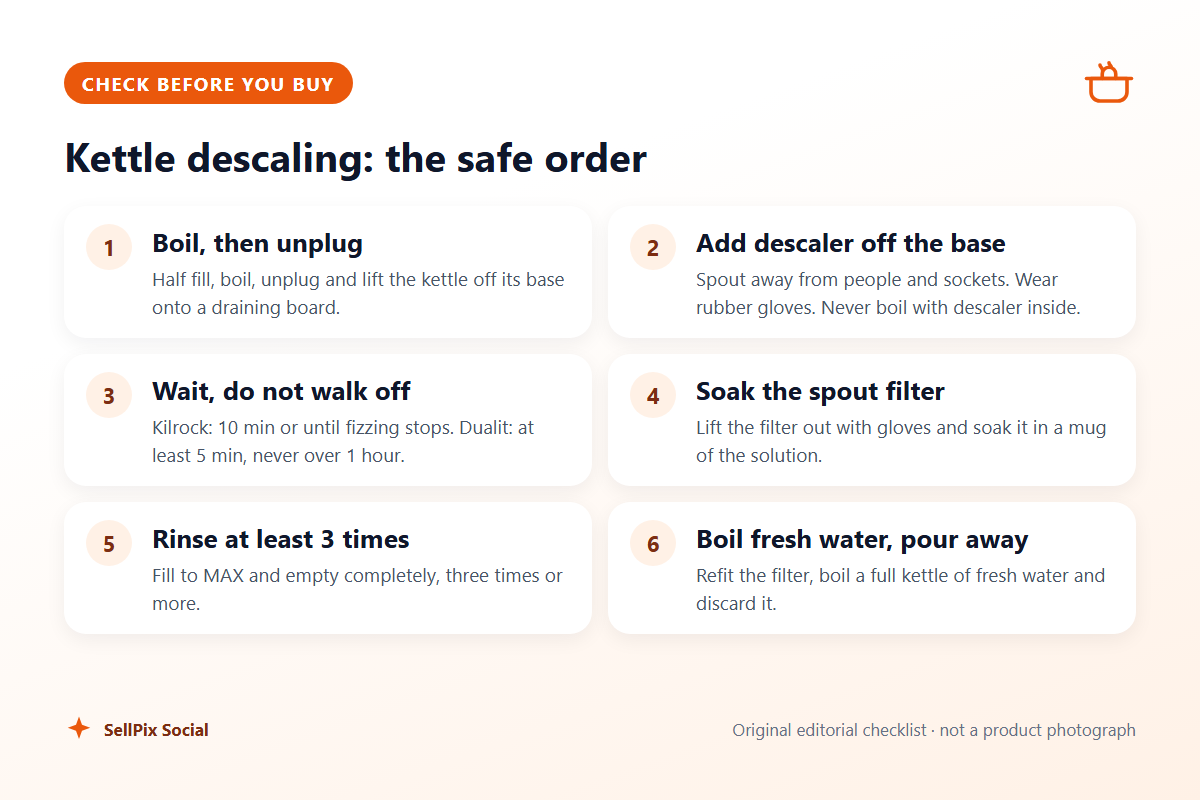
- Half fill and boil. Fill the kettle to about half with plain water and boil it. Do not overfill. Dualit's sheet then says to unplug and leave it to stand for one minute.
- Unplug and take it off the base. Lift the kettle off its power base and stand it on a draining board or in the sink. Kilrock suggests standing it in the sink to catch any fizzing over.
- Add the descaler. Kilrock's dose for a kettle is one 80 ml measure (the cap is the measure). Point the spout away from people, sockets and walls that cannot get wet. If scale sits above the water line, Dualit says you can top up with water from the hot tap.
- Wait, but never boil it. Kilrock's page says to leave it 10 minutes or until the fizzing stops. Dualit's sheet says a minimum of 5 minutes or until the limescale has gone, and no longer than 1 hour. Both are maker instructions for the same product used in different kettles, so use your kettle maker's figure if it gives one. Never switch the kettle on to boil with descaler inside: Dualit warns of scalding and chemical inhalation. The Oust sachet directions differ slightly: if scale remains after 6 minutes, they allow reheating the solution until it fizzes but say not to boil it because it may overflow. If your kettle maker says never to heat a descaler, that instruction wins.
- Soak the spout filter. With gloves on, open the lid (steam will escape) and lift out the filter. Put it in a large mug and pour in just enough of the solution to cover it.
- Empty and rinse at least three times. Pour the rest away, then fill the kettle to MAX with fresh water and empty it completely, three times or more. Dualit warns that skipping this risks swallowing the chemical.
- Wash the filter and refit it. Pour the mug away, hand wash the filter and the mug.
- Boil fresh water and throw it away. Fill to MAX, boil, discard. Kilrock also says to reboil with fresh water, pour away and rinse before use. For a heavily scaled kettle, Dualit says you may repeat the whole process.
- Clean up. Once cool, wipe up any spills straight away and wash your hands.
Mistakes that cause damage or injury
- Boiling with descaler inside. This is the warning both makers print most prominently. The solution can foam out of the spout.
- Doing it on the base. Take the kettle off the power base so spills cannot reach the connector.
- Spills on stone or enamel. Dualit's sheet says not to use the descaler on marble or enamel surfaces and not to stand the bottle on a worktop. Wipe the bottle after use.
- One quick rinse. Rinse at least three times and boil one kettle of fresh water to pour away.
- Wandering off. Stay nearby while the solution is in the kettle and while it fizzes.
How often to descale in a hard water area
There is no single national rule; it depends on your hardness band, how many times a day you boil and what your kettle maker says. Dualit recommends descaling its kettles at least once a month. The Oust sachet listing on Amazon.co.uk says to descale appliances every 3 months in hard water areas and every 6 months in soft water areas. Those two figures are not in conflict: Dualit's is a kettle maker protecting its guarantee, Oust's is a general rule for small appliances. If your kettle manual gives a frequency, follow it; if it does not, monthly in a hard or very hard area and quarterly in a moderately hard one is a sensible starting point. A practical test: if you can see a white crust on the base plate or flakes in your mug, it is time, whatever the calendar says.
Preventing scale between descales
Thames Water suggests two simple habits: drop a stainless steel scale collector into the kettle, and empty the kettle if you are not going to use it for a while, so water is not left standing. Boiling only the water you need also means less water heated and less scale. A filter jug with a limescale cartridge reduces scale further, but it adds cartridge costs, so it suits households that also want it for taste.
Buying decision
- Choose a liquid descaler such as Kilrock-K if you descale often (monthly in a hard water area), want to adjust the amount for a small travel kettle or for coffee machines and irons, and are happy to measure with the cap. It is also the product Dualit names for its kettles.
- Choose single-dose sachets such as Oust if you descale occasionally, want a pre-measured dose with nothing to pour from a bottle, or keep one in a holiday let or office kitchen.
- Skip both if your kettle manual names a specific descaler or forbids acid descalers, or if the kettle is cracked, leaking or trips the electrics. Electrical Safety First says to stop using a damaged kettle.
Kilrock-K Multi-purpose Descaler Limescale Remover 250ml Phosphate Free
A liquid multi-purpose descaler in a 250 ml bottle. Kilrock's kettle method is one 80 ml capful added to just-boiled water, left for 10 minutes or until the fizzing stops, then rinsed and followed by a boil of fresh water. Dualit recommends it for its kettles.
Oust Powerful All-Purpose Descaler, 3 Sachets x 6 (18 Sachets Total)
Single-dose liquid descaler sachets for kettles, irons, coffee machines and shower heads. The listing gives a 6-minute contact time, two sachets for heavy scale, and descaling every 3 months in hard water areas. This listing is a multipack of six 3-sachet packs.
| Kilrock-K Multi-Purpose Descaler 250ml | Oust All Purpose Descaler sachets | |
|---|---|---|
| Format | Liquid bottle, cap is the measure | Single-dose sachets (listing: 6 packs of 3) |
| Kettle dose | One 80 ml measure (Kilrock) | One sachet; two for heavy scale (listing) |
| Contact time | 10 min or until fizzing stops (Kilrock); Dualit sheet: 5 min to 1 hour | 6 minutes (listing) |
| If scale remains | Repeat the process (Dualit) | Reheat until it fizzes, do not boil (listing) |
| Acid named | Formic acid (Dualit/Kilrock sheet) | Lactic acid (listing) |
| Frequency guidance | Dualit kettles: at least monthly | Every 3 months hard water, 6 months soft (listing) |
| Surface warning | Not on marble or enamel (Dualit sheet) | Follow the sachet |
| Gloves | Yes, rubber gloves | Follow the sachet |
Before you order
- Check your kettle manual first: some makers name a descaler, a dose or a maximum contact time.
- Check the format: Kilrock is a bottle measured with its cap; Oust comes as single sachets. Count how many treatments a pack gives at your descaling frequency.
- Both are acid products with hazard warnings. Store them high up, away from children, and keep gloves next to them.
- If your kitchen has a marble, natural stone or enamel sink or worktop, plan where you will pour and stand the bottle.
- Check that the listing is the descaler you want and not a bundle with a different cleaner.
FAQ
Can I use vinegar or citric acid instead?
Some people do, but the safe method above is written for proper kettle descalers, with doses and contact times set by the maker. Electrical Safety First's advice is not to use any cleaner inside a kettle apart from products designed for descaling kettles. Follow your kettle manual.
Why boil the water first if I must not boil the descaler?
Hot water makes the descaler work faster. You heat plain water, switch off and unplug, and only then add the descaler, so the solution is never heated by the element.
How do I know the descale is finished?
Kilrock's page says when the fizzing stops. Dualit's sheet says when all the limescale has gone, but no longer than 1 hour. If scale remains, repeat rather than leaving it longer.
Is limescale harmful to drink?
Thames Water says hard water is not considered harmful. Descale for the kettle's sake and the taste of your tea, but rinse thoroughly so no descaler residue is left.
Do I need to descale a kettle in a soft water area?
Less often. Scale forms more slowly in soft water. Check the base plate every few months and descale when you see a crust.
How we researched this
On 2026-10-10 we read Kilrock's own instructions for its multi-purpose descaler, the Kilrock K descaling instruction sheet Dualit publishes for its kettles, Thames Water's hard water page and Electrical Safety First's kettle safety advice, and checked both Amazon.co.uk listings. We did not descale a kettle for this article and did not test the products. Oust contact times are taken from the Amazon.co.uk listing because Oust's own website could not be opened when we checked; the printed sachet instructions take priority. Buying links and any commission relationship are disclosed on this page.
Sources
Related guides
Ninja Foodi Dual Zone AF300UK vs Tower Vortx 9L dual basket air fryer: which should you buy?
Two dual-drawer air fryers sold widely in the UK, compared from the makers' own specifications and the Amazon.co.uk listings: what fits in each drawer, Sync and Match, viewing windows, worktop footprint, cleaning and warranty, plus what the Energy Saving Trust says about air fryer versus oven running costs.
Heated throw running costs in the UK: how to work them out, and Beurer HD 75 vs Silentnight Comfort Control
A heated throw's running cost is simple arithmetic: rated watts divided by 1000, times hours, times your unit rate. We show the method, explain why the result is a ceiling rather than a measurement, and compare two UK-plug throws on size, heat settings, auto switch-off, washing and what their listings actually publish, finishing with Electrical Safety First's safety checklist.
Filter jug for hard water: is it worth it, and which one should you buy?
What a filter jug does and does not do in a UK hard water area: less kettle scale and better-tasting tea, not a softened house. How to pick the cartridge first and the jug second, how many cartridges a year you will need, what fits a fridge door, and when to use plain tap water instead, including for baby formula.