'/%3e%3cpath%20d='M31%2038c0-8%206-14%2014-14h38c8%200%2014%206%2014%2014v52c0%208-6%2014-14%2014H45c-8%200-14-6-14-14V38z'%20fill='url(%23tmPanel)'%20filter='url(%23tmShadow)'/%3e%3cpath%20d='M44%2044h40'%20fill='none'%20stroke='%23f97316'%20stroke-width='8'%20stroke-linecap='round'/%3e%3cpath%20d='M44%2061h24'%20fill='none'%20stroke='%23fdba74'%20stroke-width='8'%20stroke-linecap='round'/%3e%3cpath%20d='M43%2087l13-14%2011%2010%2017-21%202%2025H43z'%20fill='%23fb923c'/%3e%3ccircle%20cx='84'%20cy='58'%20r='6'%20fill='%23f97316'/%3e%3cpath%20d='M77%2091l16-18%2014%2014'%20fill='none'%20stroke='%2316a34a'%20stroke-width='7'%20stroke-linecap='round'%20stroke-linejoin='round'/%3e%3cpath%20d='M99%2074h-6v-6'%20fill='none'%20stroke='%2316a34a'%20stroke-width='7'%20stroke-linecap='round'%20stroke-linejoin='round'/%3e%3cpath%20d='M30%2034c8-10%2020-15%2034-15s26%205%2034%2015'%20fill='none'%20stroke='%23fff7ed'%20stroke-width='5'%20stroke-linecap='round'%20opacity='.92'/%3e%3cpath%20d='M27%2096c9%208%2021%2012%2037%2012s28-4%2037-12'%20fill='none'%20stroke='%23fff7ed'%20stroke-width='5'%20stroke-linecap='round'%20opacity='.72'/%3e%3c/svg%3e)
Bedroom humidifier buying guide: pick the type first, then the cleaning routine you can keep
Ultrasonic or evaporative? For a bedroom the real choice is between quiet mist that needs distilled water and a wick unit that needs filters. We compare the Levoit Classic 300S and Honeywell HCM350B against EPA cleaning advice and humidity limits.
Quick answer: If you have hard tap water or do not want to buy distilled water, choose an evaporative (wick) humidifier such as the Honeywell HCM350B and budget for replacement filters. If silence and an easy top-fill tank matter most and you will use distilled or low-mineral water, an ultrasonic unit such as the Levoit Classic 300S is the better fit. Either way, plan on emptying it daily, cleaning it every third day as the EPA advises, and keeping the bedroom at or below 50% relative humidity.
Start with the type, not the model
Most bedroom humidifiers sold in the US are cool-mist units of two kinds, and the type decides more about daily life than any feature list.
Ultrasonic humidifiers vibrate water into a fine visible mist. They are usually very quiet and need no filter. The trade-off, according to the US EPA's guide to home humidifiers, is that ultrasonic and impeller units "can disperse materials, such as microorganisms and minerals" from the tank into the air. Minerals show up as a fine white dust on furniture. The EPA's remedy is water with low mineral content, such as distilled water.
Evaporative humidifiers blow air through a wet wick or filter. The EPA says they "generally disperse less, if any" of those pollutants, which makes them more forgiving if you use tap water. The trade-offs are a fan sound and a wick that has to be replaced, and the EPA notes that a wet wick with standing water can still grow microbes if it is neglected.
Warm-mist (steam) units boil water. The EPA says steam and evaporative units are not expected to release substantial minerals, but both the EPA and MedlinePlus warn about burns; MedlinePlus recommends cool-mist units, especially around children. This guide sticks to cool-mist models for that reason.
How much humidity a bedroom actually needs
More is not better. The EPA's humidifier page says plainly: do not humidify above 50% relative humidity, because higher levels encourage biological growth. Its separate mold and moisture guide gives the wider target: keep indoor humidity below 60%, "ideally between 30 and 50 percent." MedlinePlus suggests setting a humidifier to 40% to 50%.
Practical reading of those three sources: aim for roughly 40% to 50% in a bedroom in winter, and treat 50% as the ceiling. If you see condensation on windows or walls, the EPA says to turn the humidity down. A cheap hygrometer is the only way to know where you are, unless the humidifier has a reliable built-in sensor.
The cleaning routine decides whether you keep using it
A humidifier you stop cleaning is worse than none. The EPA advises, for portable units:
- Every day: empty the tank, dry the surfaces and refill with fresh water.
- Every third day: clean away scale and film. If the maker gives no method, the EPA suggests a 3% hydrogen peroxide solution on all surfaces that touch water, then a thorough rinse.
- Always: unplug the unit before emptying or cleaning, and follow the maker's replacement schedule for filters and cartridges.
- End of season: clean it and store it dry.
Some manuals are less strict. Levoit's Classic 300S manual says to change the water daily and clean weekly. Where the maker and the EPA differ, the stricter schedule costs a few extra minutes and removes the doubt. When you compare models, look at how many parts touch water, whether the tank opening fits a hand or a brush, and whether anything can go in the dishwasher.
Size the tank to one night, not one week
For a bedroom you want a tank that runs from bedtime to morning on a low setting without a refill, but you will still empty it every day. Bigger tanks are heavier to carry to the sink and do not save cleaning time. Run-time figures are maker numbers on the lowest setting: Levoit quotes up to 60 hours for a 6-liter tank and notes the real figure depends on room temperature and humidity; Honeywell quotes up to 24 hours for its HCM350.
Placement in a bedroom
MedlinePlus suggests placing a humidifier several feet (about 2 meters) from the bed. Levoit's manual says to aim the mist away from walls, furniture, bedding and appliances and not to set the unit on carpet, which can block its air inlet. Honeywell's manual asks for a firm, level spot at least 6 inches (15 cm) from walls and furniture, on a water-resistant surface. A dresser top with a tray under the unit works for both.
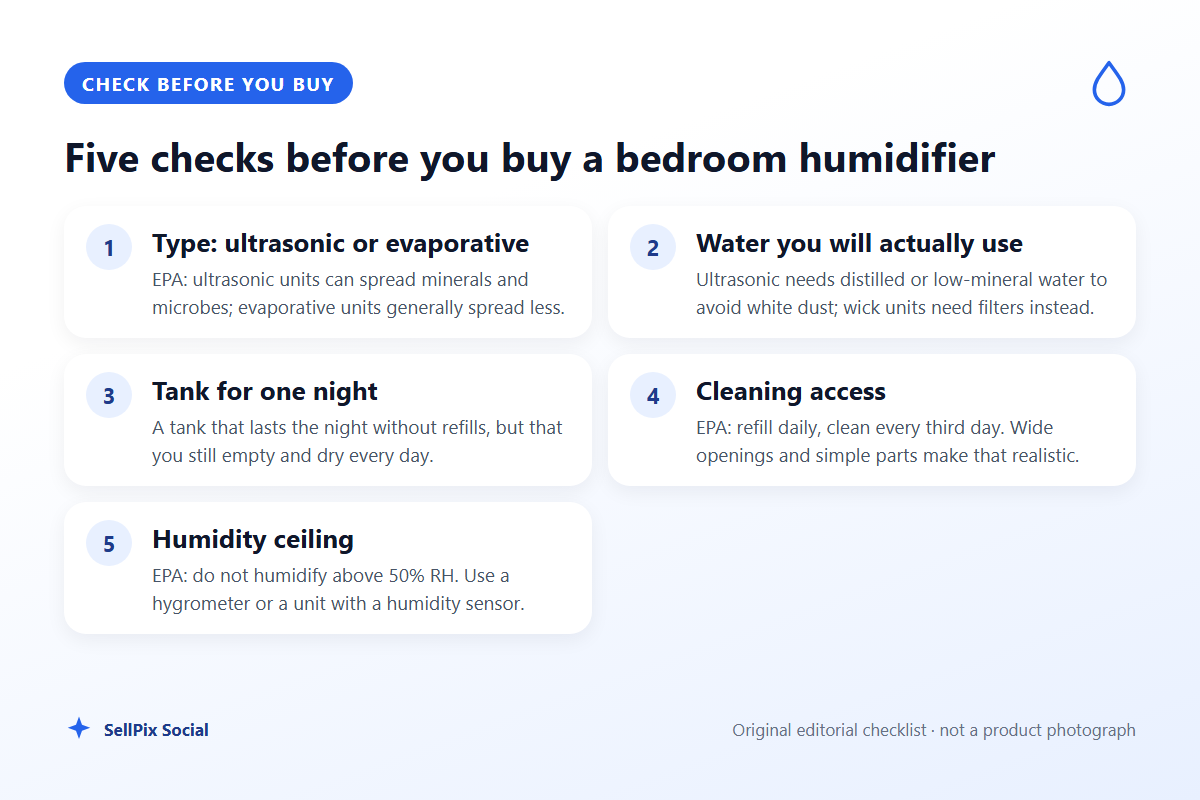
Buying decision
- Choose the Levoit Classic 300S if you sleep light, want a top-fill tank you can pour into without flipping it, and will buy distilled or purified water. Its auto mode uses a humidity sensor and, per the manual, aims for 40% to 50% by default, which keeps you under the EPA ceiling without a separate gadget.
- Choose the Honeywell HCM350B if your tap water is hard, you would rather replace a filter than buy distilled water, and a soft fan sound does not bother you. Its tank is listed as dishwasher safe, which helps with the every-third-day cleaning.
- Skip both if you are not willing to empty the tank daily, or if your bedroom already sits above 50% humidity in winter; in that case the problem is moisture, not dryness. Anyone with breathing symptoms that seem linked to a humidifier should stop using it and talk to a doctor, as the EPA advises.
Levoit Classic300S Ultrasonic Smart Top Fill Humidifier, Large 6L Tank
A quiet ultrasonic cool-mist humidifier with a 6-liter top-fill tank, a humidity sensor with an auto mode and app control. Best with distilled or purified water; tap water can leave white mineral dust.
Honeywell Cool Moisture Humidifier, 1.1 Gallon, UV Technology, Black, HCM350B
An evaporative humidifier: a UV light treats the water and a wicking filter holds minerals back, so it releases invisible moisture instead of visible mist. A good match for hard-water homes, at the cost of replacement filters.
| Check | Levoit Classic 300S | Honeywell HCM350B |
|---|---|---|
| Type | Ultrasonic cool mist | Evaporative (wick filter) with UV |
| Tank (maker / listing) | 6 L / 1.58 gal, top fill | 1.1 gal, self-standing tank |
| Run time (maker, lowest setting) | Up to 60 hours | Up to 24 hours |
| Water | Purified or distilled recommended | Tap water; wick captures minerals |
| Humidity control | Sensor; auto mode targets 40–50% | Three fan speeds, no humidity setting |
| Ongoing part | None required; descale with vinegar | HAC-504 Filter A wick; UV bulb |
| Cleaning per manual | Change water daily, clean weekly, no dishwasher | Vinegar descale, then bleach disinfect; tank dishwasher safe |
| Sound | Maker lists 30 dB | Fan sound; low speed for night |
Before you order
- Check the exact model: the Honeywell listing here is the black HCM350B; the white HCM350W uses the same HAC-504 Filter A, but confirm the filter on the listing you buy.
- Make sure the Levoit listing says Classic 300S, the smart, app-controlled version described here; a similarly named model without the S is a different product.
- Decide on water before you order. If you will not buy distilled water, the ultrasonic option will leave white dust in hard-water areas.
- For the Honeywell, order a spare genuine Filter A with the unit so you are not waiting when the wick hardens.
- Buy a hygrometer if your unit has no humidity sensor, and read the return policy in case the sound does not suit your room.
FAQ
Is an ultrasonic or evaporative humidifier better for a bedroom?
Ultrasonic is quieter and has no filter, but the EPA notes it can spread minerals and microbes from the tank, so it needs distilled or low-mineral water and strict cleaning. Evaporative units spread less of both but make fan noise and need replacement wicks. Hard water favors evaporative; light sleepers with distilled water often prefer ultrasonic.
What humidity should I set in my bedroom?
The EPA says not to humidify above 50% relative humidity and, in its mold guide, gives an ideal indoor range of 30% to 50%. MedlinePlus suggests 40% to 50%. Aim for the 40s and stop when windows start to fog.
How often should I clean a bedroom humidifier?
The EPA recommends emptying, drying and refilling portable humidifiers daily and cleaning them every third day. Follow the maker's method for cleaning agents; if there is none, the EPA suggests 3% hydrogen peroxide and a good rinse.
Can I use tap water in an ultrasonic humidifier?
It will run, but minerals in tap water can come out as white dust. The EPA and MedlinePlus both point to distilled water, and Levoit recommends purified or distilled water for the Classic 300S.
How far from the bed should a humidifier be?
MedlinePlus suggests several feet, about 2 meters. Keep the mist away from bedding and walls and put the unit on a water-resistant, level surface.
How we researched this
On 2026-10-10 we read the EPA's humidifier care page and its mold and moisture guide, the MedlinePlus humidifier article, the Levoit Classic 300S US user manual, and Honeywell's HCM350 product page and owner's manual, and we checked both Amazon.com listings named below. We did not buy or test either humidifier; sound, run time and output figures are the makers' claims. Where a listing and the maker disagree (Honeywell's page says 1.1 gallons in its headline and "1 gallon tank" in its details), we say so. Still worth checking yourself: the current filter part number on your listing and your local water hardness. Buying links and any commission relationship are disclosed on this page.
Sources
- US EPA: Use and Care of Home Humidifiers
- US EPA: A Brief Guide to Mold, Moisture and Your Home
- MedlinePlus (NIH): Humidifiers and health
- Levoit Classic 300S US user manual (PDF)
- Honeywell Plugged In: Cool Moisture Humidifier HCM350
- Honeywell HCM-350 owner's manual (PDF)
- Amazon.com listing, ASIN B09C24TYGQ
- Amazon.com listing, ASIN B00FJTVHKO
Related guides
Bissell Little Green vs Hoover CleanSlate XL: which portable spot cleaner fits pet stains and upholstery?
The Little Green 1400B is the lighter, simpler machine for small accidents and car seats; the CleanSlate XL doubles the tank and adds a 7-inch tool for bigger patches. Neither heats water. Here is how tank size, tool width, reach and fabric checks change the choice.

Countertop nugget ice maker buying guide: texture, storage and daily upkeep
Evaluate EUHOMY Pearl H1 by ice texture, basket capacity, refill routines and cleaning. Understand production claims before buying a countertop ice maker.

Ninja CREAMi Deluxe buying guide: choose the model before the recipe
Compare CREAMi model choices, freezer preparation and tub compatibility before buying a Deluxe. Research-based guidance with clear purchase checks.