'/%3e%3cpath%20d='M31%2038c0-8%206-14%2014-14h38c8%200%2014%206%2014%2014v52c0%208-6%2014-14%2014H45c-8%200-14-6-14-14V38z'%20fill='url(%23tmPanel)'%20filter='url(%23tmShadow)'/%3e%3cpath%20d='M44%2044h40'%20fill='none'%20stroke='%23f97316'%20stroke-width='8'%20stroke-linecap='round'/%3e%3cpath%20d='M44%2061h24'%20fill='none'%20stroke='%23fdba74'%20stroke-width='8'%20stroke-linecap='round'/%3e%3cpath%20d='M43%2087l13-14%2011%2010%2017-21%202%2025H43z'%20fill='%23fb923c'/%3e%3ccircle%20cx='84'%20cy='58'%20r='6'%20fill='%23f97316'/%3e%3cpath%20d='M77%2091l16-18%2014%2014'%20fill='none'%20stroke='%2316a34a'%20stroke-width='7'%20stroke-linecap='round'%20stroke-linejoin='round'/%3e%3cpath%20d='M99%2074h-6v-6'%20fill='none'%20stroke='%2316a34a'%20stroke-width='7'%20stroke-linecap='round'%20stroke-linejoin='round'/%3e%3cpath%20d='M30%2034c8-10%2020-15%2034-15s26%205%2034%2015'%20fill='none'%20stroke='%23fff7ed'%20stroke-width='5'%20stroke-linecap='round'%20opacity='.92'/%3e%3cpath%20d='M27%2096c9%208%2021%2012%2037%2012s28-4%2037-12'%20fill='none'%20stroke='%23fff7ed'%20stroke-width='5'%20stroke-linecap='round'%20opacity='.72'/%3e%3c/svg%3e)
Baby room temperature and tog: how to dress your baby for sleep
The NHS and The Lullaby Trust recommend a room of about 16-20°C, a room thermometer, and a well-fitting sleeping bag or light bedding. This guide sets out their advice on layers, hats and checking your baby, explains what a tog rating can and cannot tell you, and looks at a thermometer and a 2.5 tog bag sold on Amazon.co.uk.
Quick answer: The NHS and The Lullaby Trust recommend keeping the room where your baby sleeps at about 16-20°C, checking it with a room thermometer, and using a well-fitting baby sleep bag or light bedding, with no duvets, pillows or hats indoors. Choose the sleep bag's tog using the maker's own guide for your room temperature, then check your baby by feeling their chest or the back of their neck: if their skin is hot or sweaty, take off a layer. The Lullaby Trust does not publish a tog chart, so treat any temperature-to-tog guide as the manufacturer's, not official advice.
What the official advice says
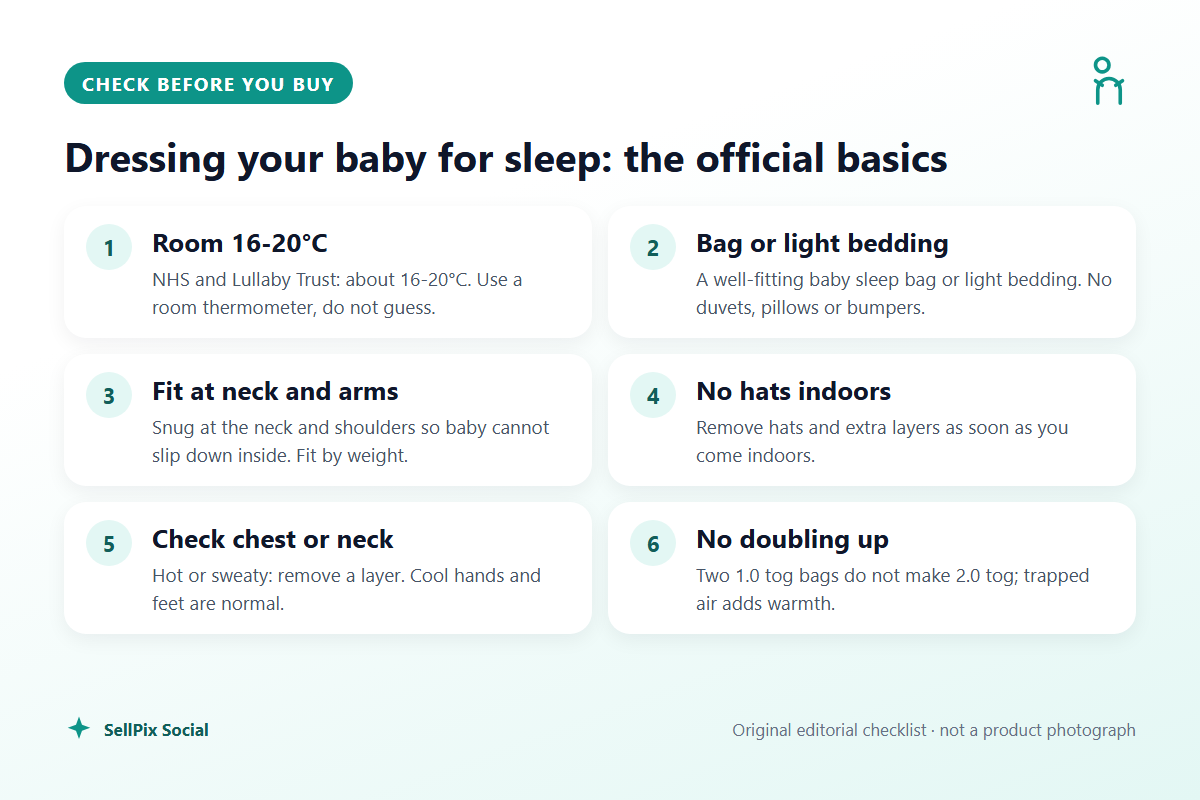
The NHS page on sudden infant death syndrome (SIDS) says overheating can increase the risk of SIDS. It advises keeping the room at between about 16 and 20°C, using a room thermometer, and removing hats and extra clothing as soon as you come indoors or into a car, even if that wakes your baby. It says to check your baby's temperature by feeling their chest or the back of their neck, and not to worry if their hands or feet feel cool, because that is normal.
The Lullaby Trust's room temperature page gives the same 16-20°C range and adds that, at this temperature, light bedding or a lightweight, well-fitting baby sleep bag is comfortable. It stresses that every baby is different, so the range is a guide and you still need to check your baby regularly.
The NHS also says to place babies on their back to sleep, on a firm, flat mattress, with the cot kept clear of anything that could cover their face or head.
What to wear for the room temperature
The Lullaby Trust's guide to dressing your baby for sleep sets out options by room temperature:
| Room temperature | Lullaby Trust guidance | If your baby feels cold or hot |
|---|---|---|
| Cooler than 16°C | With a sleep bag, do not add blankets on top | Add a layer of clothing or choose a higher tog sleep bag |
| 16-20°C | A baby grow and a sleep bag, or a baby grow with a firmly tucked, lightweight blanket | Check chest or back of neck; remove a layer if hot or sweaty |
| Warmer than 20°C or hot weather | A lightweight layer such as a short-sleeve bodysuit, or just a nappy | Lighter bedding; open a door and window if safe |
For cold nights, the Trust says it is rarely necessary to keep the heating on all night, and an extra layer of clothing usually helps. If you do leave it on, keep it low, and no higher than 20°C. Keep the cot or Moses basket away from radiators, heaters and direct sunlight. In hot weather, a fan can help cool the room, but should not be aimed directly at your baby.
What a tog rating can and cannot tell you
Tog is a measure of insulation: the higher the number, the warmer the product. The Lullaby Trust says to use a lower tog in warmer rooms and a higher tog in cooler rooms, and to follow the manufacturer's tog guide for the room temperature.
It deliberately does not publish its own chart matching temperature to tog. Its reasons: every product uses different materials, thermal insulation differs between products, the air trapped between layers changes the warmth significantly, and every baby is different. That is why a tog number is a starting point, not a setting. Two practical consequences from the Trust's advice:
- Do not stack bags. Two 1.0 tog sleep bags do not make a 2.0 tog bag; air trapped between the layers adds warmth and can make a baby too hot.
- A folded blanket counts twice. One blanket doubled over counts as two blankets.
The Trust also does not recommend weighted swaddles, blankets or sleeping bags for babies under one year.
Sleep bag fit and safety marks
The Lullaby Trust notes that most baby sleeping bags are fitted by weight, not age, so check the manufacturer's sizing rather than relying only on the age printed on the label. The bag should be well fitted around the neck and shoulders so your baby cannot slip down inside. It also strongly recommends products that meet the relevant British Standard, especially when buying online; for baby sleeping bags that is BS EN 16781:2018.
If your baby is unwell
The Lullaby Trust says a baby with a cold or fever may feel warmer than usual and should be dressed for the room, not wrapped up more. If your baby has a high temperature or you are worried, call your GP or 111, and seek medical advice if your baby shows signs of being seriously unwell. Neither product below measures your baby's temperature.
Buying decision
A room thermometer is the one item both the NHS and The Lullaby Trust explicitly recommend. Choose the Tommee Tippee GroEgg2 if you want a thermometer you can read at a glance in the dark, with colour bands that line up with the 16-20°C range and a dimmable night light. Choose the Tommee Tippee Grobag 6-18m 2.5 tog if your baby's room usually sits in the 16-20°C range, which is the band Tommee Tippee gives for its 2.5 tog bag, and your baby is within the maker's size guidance. Skip a new bag if your current one fits well and suits the room; a cheap simple room thermometer meets the official advice as well as a smart one.
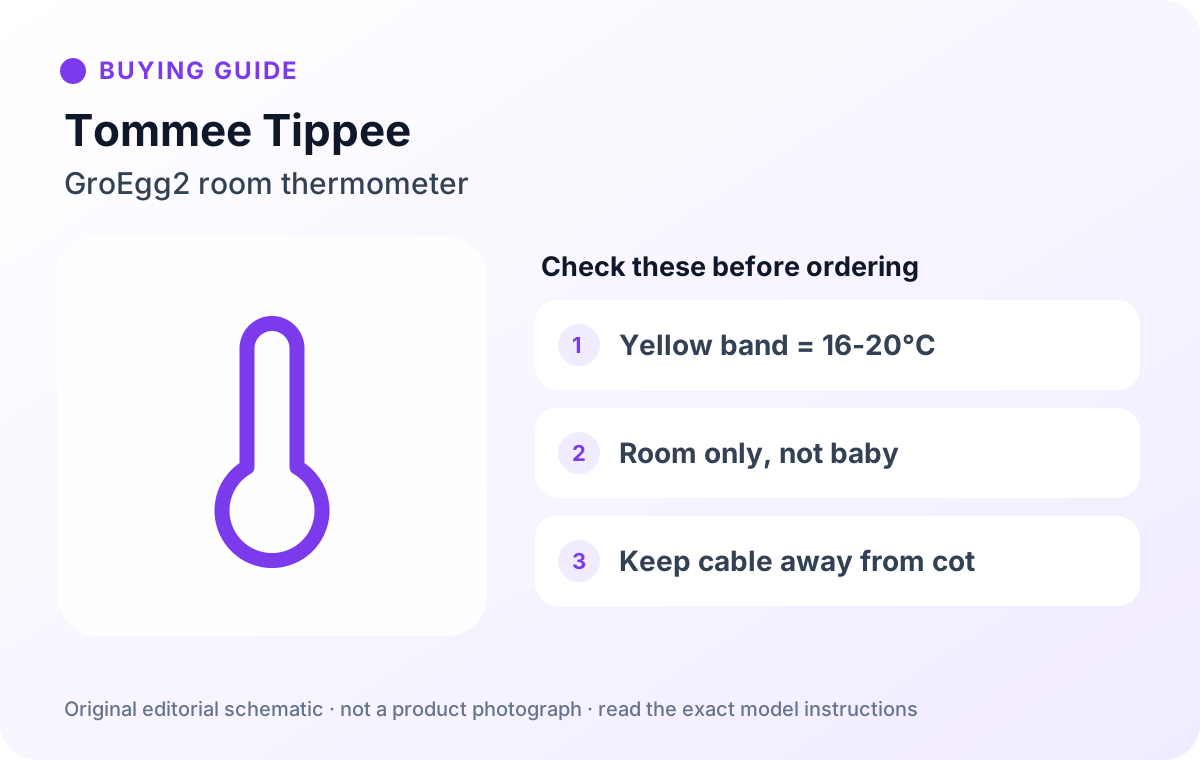
Tommee Tippee GroEgg2 Colour-Changing Room Thermometer and Night Light
A USB-powered room thermometer with a digital display and a night light that changes colour by room temperature, with bands that line up with Tommee Tippee's tog guidance.
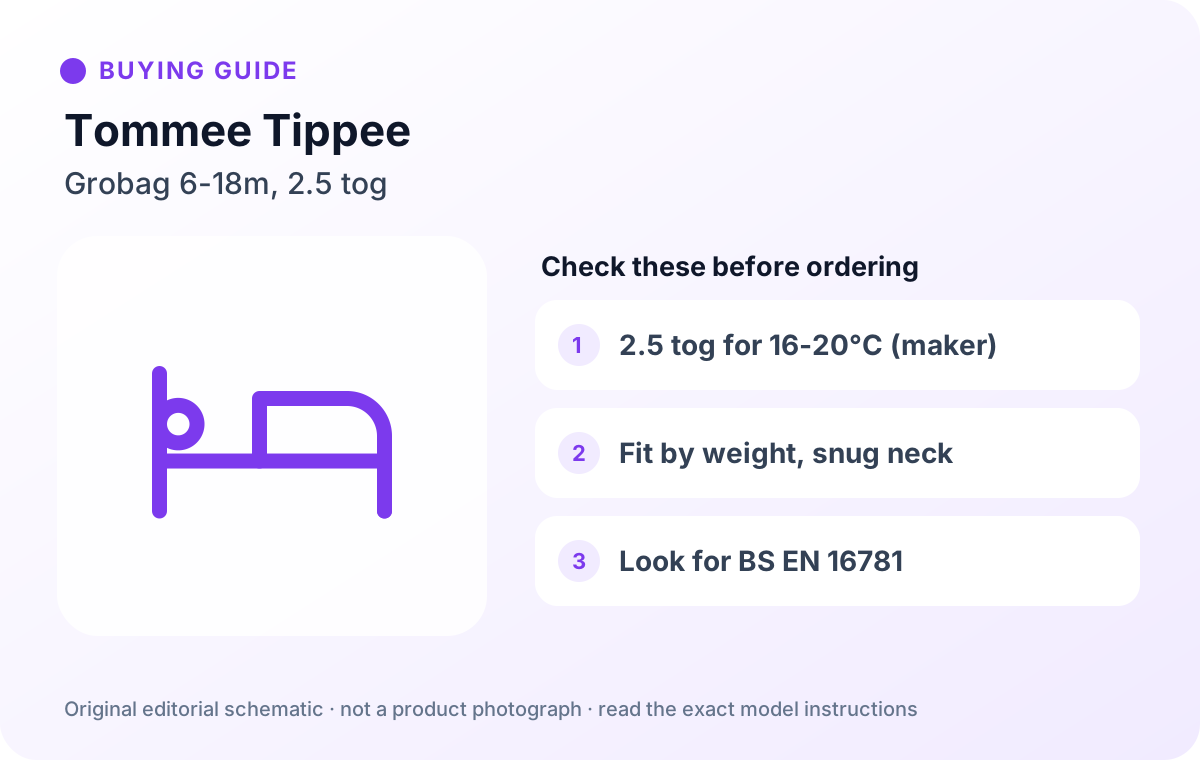
Tommee Tippee The Original Grobag Baby Sleep Bag, 6-18 months, 2.5 tog
A 2.5 tog sleeping bag for 6 to 18 months, slim at the chest and roomy at the hips, with a bottom-to-top zip. Tommee Tippee gives 16-20°C for its 2.5 tog and 20-24°C for its 1.0 tog.
| Tommee Tippee GroEgg2 | Tommee Tippee Grobag 6-18m, 2.5 tog | |
|---|---|---|
| What it does | Shows room temperature as a number and a colour | Wearable sleep bag in place of loose bedding |
| Link to the 16-20°C advice | Yellow band covers 16-20°C (listing) | Maker gives 16-20°C for 2.5 tog; 20-24°C for 1.0 tog |
| What it cannot do | Measure your baby's temperature | Replace checking your baby's chest or neck |
| Power or fit | USB powered, 200 cm cable | Snug at the chest, roomy at the hips; bottom-to-top zip |
| Check before buying | Where cable and unit will sit, out of baby's reach | Size by your baby's weight and length; BS EN 16781 label |
Before you order
- Check which tog suits your room using the maker's guide, and consider owning two togs if the room changes a lot between seasons.
- Confirm the size: Original Grobags are listed in several sizes (including 6-18m and 18-36m), in 1.0 and 2.5 tog, and as dual-tog and legged Steppeebag versions; this link is the 6-18m, 2.5 tog.
- Check the maker's weight guidance and that the neck and armholes will be snug.
- Look for BS EN 16781:2018 on the bag's label or listing.
- Place the GroEgg2 and its USB cable well away from the cot.
FAQ
What temperature should my baby's room be?
About 16-20°C, according to the NHS and The Lullaby Trust. Use a room thermometer rather than guessing.
What tog sleeping bag should my baby wear at 18°C?
The Lullaby Trust does not give a tog chart and advises following the bag maker's guide. Tommee Tippee, for example, gives 2.5 tog for 16-20°C. Then check your baby's chest or neck and adjust clothing.
Should my baby wear a hat to sleep?
No. The NHS and The Lullaby Trust say to remove hats indoors, because babies lose heat through their heads and a covered head can lead to overheating.
My baby's hands feel cold. Are they too cold?
Cool hands and feet are normal. Feel the chest or back of the neck instead. If the chest feels cold, add a layer of clothing or use a higher tog bag.
Can I put a blanket over a sleeping bag?
The Lullaby Trust says not to add blankets on top of a sleep bag; add a layer of clothing or use a higher tog bag instead.
How we researched this
On 10 October 2026 we read the NHS page on sudden infant death syndrome and The Lullaby Trust's pages on room temperature and on how to dress your baby for sleep, and checked both product listings on Amazon.co.uk. We could not open Tommee Tippee's own website, so product details come from the Amazon.co.uk listings. We did not buy or use these products. This guide summarises published safer sleep advice and is not medical advice; if you are worried about your baby, contact your GP, health visitor or 111. Buying links and any commission relationship are disclosed on this page.